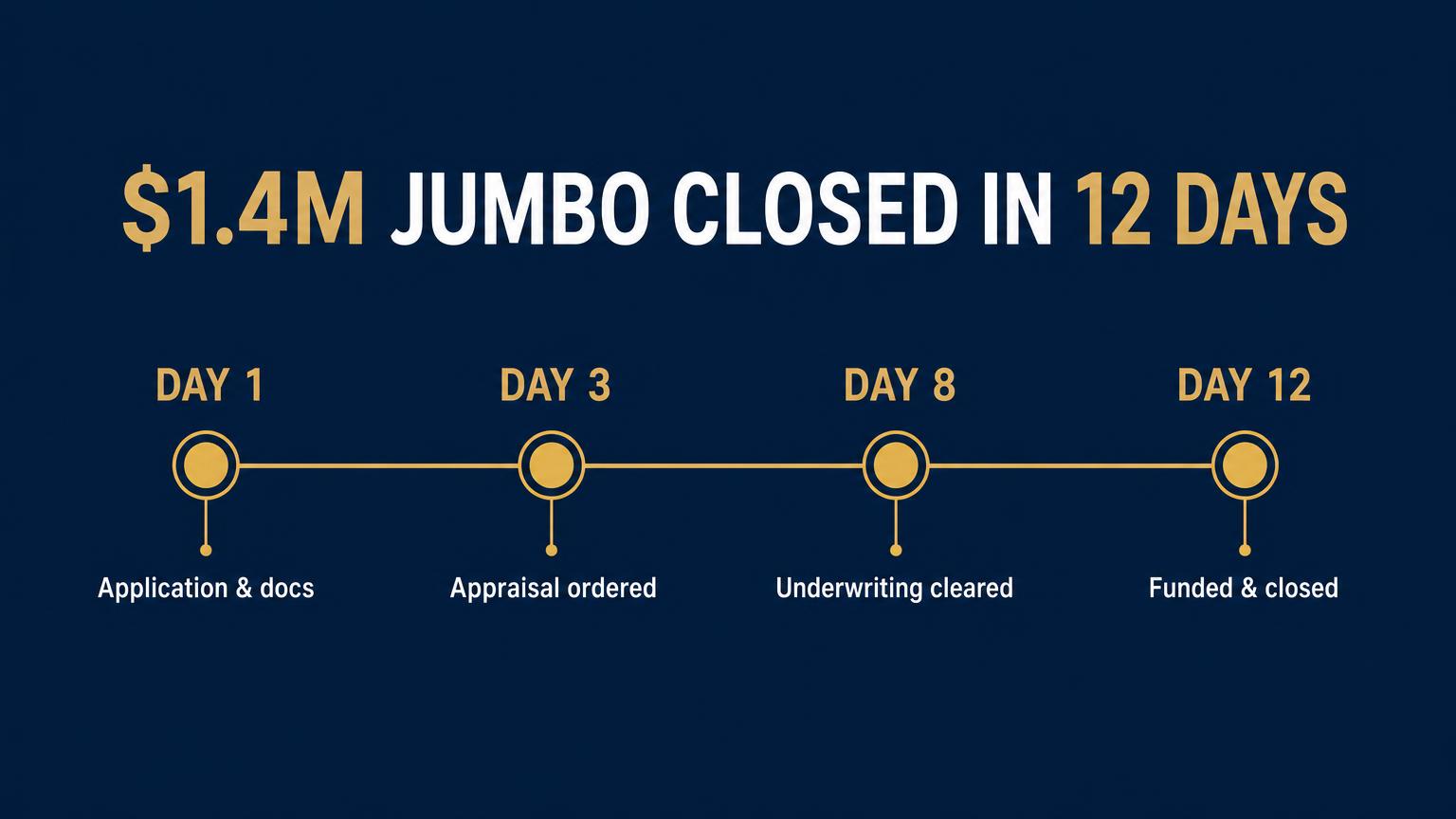
We Closed a $1.4 Million Jumbo in 12 Calendar Days. Here's What That Actually Takes.

A client called me recently with the question most loan officers quietly dread.
He had just won a multiple-offer situation on a $1.4 million home in the Chicago suburbs. To beat the other bids, he had agreed to two things: a non-refundable deposit, and a close in 12 calendar days.
He had not signed yet. He called to ask one question first — could we actually do it?
That is not a rate question. It is not even really a mortgage question. He was asking whether he could put a large sum of his own money at risk on the strength of my answer.
I told him yes. We closed on day 12.
Why I could answer that in one phone call
I don't give that answer often, and I never give it before I've looked at the file. What made this one different is that I already had.
We had his income and asset documentation. We knew what the property was. And critically, we have direct access to the underwriting desk that would be making the decision — not a ticket in a queue, not a call center, not a portal that returns an answer in four business days.
That distinction sounds like inside baseball, but on a compressed timeline it is the whole ballgame. When a question comes up on day 6 — an unusual bonus structure, a large deposit that needs sourcing, an appraisal that reads oddly — the difference between an answer in two hours and an answer in two days is the difference between closing and forfeiting a deposit.
A $1.4 million jumbo loan is not an automated decision. There is a human being underwriting it. We know who that person is, and we can reach them.
What actually had to happen in 12 days
Here is the shape of a compressed jumbo close. Nothing here is exotic. It is ordinary work done in the right order, with nobody waiting on anybody.
| Day | What happened |
|---|---|
| Day 1 | Complete application. Full document package requested and delivered the same day. Appraisal ordered immediately on a rush. Initial disclosures out. |
| Day 2 | File submitted to underwriting fully packaged. This is the step most lenders get wrong. Submitting a partial file to "get in the queue" feels faster and costs you three days on the back end when it returns with conditions that were avoidable. |
| Day 3 | Conditional approval back. |
| Days 4–5 | Appraisal inspection completed, report expedited. |
| Day 6 | Appraisal received and reviewed. Title commitment in. |
| Day 7 | Remaining conditions cleared. Verification of employment, reserves documented, source of funds confirmed. |
| Day 8 | Clear to close. Closing Disclosure issued. |
| Days 9–11 | The mandatory three-business-day Closing Disclosure waiting period runs. Final figures to the title company. Wire instructions confirmed. |
| Day 12 | Signing, funding, recording. |
Notice where the slack is: there isn't any. And notice day 8. Federal rules require the borrower to receive the Closing Disclosure at least three business days before signing. That window cannot be shortened, waived, or hurried. It is the reason 12 days is close to the floor for a purchase — everything else can be compressed, but that clock runs at its own speed.
Which means a 12-day close is really an 8-day underwriting job. Every hour lost in the first week comes directly out of your margin for error.
So why is our average 21 days, not 12?
Because 21 days is what we can do routinely, and 12 is what we can do when everything and everyone aligns.
Our 21-day average includes normal files. Borrowers who take three days to send documents because they're at work. Appraisers booked out in a busy month. Condo associations that take a week to return a questionnaire. Sellers who need a longer close because they're buying a home themselves.
Twelve days required a borrower who returned every document within hours, a property that appraised without complication, and a title file with nothing buried in it. That is not the typical transaction, and I would not promise it sight unseen.
What I will do is tell you honestly, up front, what your specific file can do. That is a more useful commitment than a number on a billboard — and it's the same reason I tell clients to stop waiting for the perfect rate and start working with the numbers actually in front of them.
What actually slows a closing down
In my experience, delays almost never come from underwriting being slow. They come from these:
Incomplete document packages
Sending nine of the eleven items requested doesn't start the clock at nine-elevenths. It usually doesn't start it at all.
Unsourced deposits
A $40,000 transfer into your account with no paper trail will stop a file cold. Gift funds, proceeds from a sale, moving money between your own accounts — all fine, all need documentation.
Appraisal scheduling
Unique or high-value properties take longer, and some jumbo programs require a second appraisal. Ordering on day one instead of day three matters more than people expect.
Condo and HOA documents
In the Chicago market this is the single most common source of delay. The association controls the timeline, and the association is not in a hurry.
Changes mid-process
A new car loan, a job change, moving money around, opening a store credit card at the furniture showroom. Any of these can require re-underwriting days before closing.
Title surprises
Old liens, estate matters, judgments, name mismatches. Ordering title early is how you find these while there's still time to clear them.
None of these are exotic. All of them are avoidable if the file is built properly in the first week. And if your income is structured in a way that doesn't fit a standard W-2 box — self-employment, bonus-heavy compensation, rental income — the answer is usually documentation, not rejection. That's most of what non-QM lending exists to solve.
If you're heading into a multiple-offer situation
Some practical advice, whether or not you work with us.
Get underwritten, not just pre-approved
A pre-approval based on a soft credit pull and stated income is a marketing document. An underwritten approval, with income and assets already reviewed by the person who will make the decision, is what lets you shorten a timeline credibly. If you're newer to this, our Naperville first-time buyer guide walks through what that process looks like from the start.
Ask your lender the direct question before you write the offer
"What is the fastest you can close this specific file, and what would have to be true for that to happen?" If they can't answer in a phone call, you have your answer.
Ask who is underwriting your loan
If your lender can't tell you, they don't have the access that a compressed close requires.
Never waive protection without a conversation first
Don't agree to a non-refundable deposit or waive a financing contingency without talking to your loan officer. My client did exactly the right thing. He called before he signed, not after.
He got the house.
Common questions
How fast can a mortgage actually close?
Our average purchase closing is 21 calendar days. Twelve days is achievable when the borrower returns documents immediately, the appraisal is straightforward and title is clean. The federal Closing Disclosure rule requires the borrower to receive the disclosure at least three business days before signing, which sets a practical floor on how fast any purchase can close.
Can a jumbo loan close as fast as a conventional loan?
Yes, though it takes more coordination. Jumbo loans above the conforming limit are underwritten by a person rather than an automated system, and some programs require a second appraisal. Direct access to the underwriting desk is what makes a compressed jumbo timeline realistic.
What most often delays a mortgage closing?
Incomplete document packages, large deposits that haven't been sourced, appraisal scheduling on unique or high-value properties, condominium and HOA document turnaround, changes to credit or employment mid-process, and title issues such as old liens or name mismatches.
Should I waive my financing contingency to win a multiple-offer situation?
Never without speaking to your loan officer first. Ask your lender what the fastest realistic closing is for your specific file and what would have to be true for that timeline to hold. If they can't answer in a phone call, that's your answer.
Closing timelines vary by file, property type, loan program and third-party turn times. No specific closing timeline is guaranteed. Details of the transaction described have been generalized to protect client privacy.
Follow us on Google: Add ABS Home Mortgage as a preferred source
Related Reading
Denied by a Bank? Why a Non-QM Loan Might Be Your Path to the Home You Want
Non-QM loans use flexible underwriting — bank statements, assets, 1099s, or rental income instead of just tax returns. Here's how they work.
Read articleFirst-Time Home Buyer Guide: Naperville 2026
What you can actually afford with DuPage County taxes, down payment minimums, neighborhood pricing by ZIP, Illinois assistance programs, and the pre-approval process.
Read articleInside a 21-Day Close: What Happens Each Week, and What Slows It Down
Our average purchase closing is 21 calendar days. Here's exactly what happens each week — documents, underwriting, appraisal, title, and the Closing Disclosure clock.
Read articleMore in Jumbo & Non-QM · All mortgage guides