Inside a 21-Day Close: What Happens Each Week, and What Slows It Down

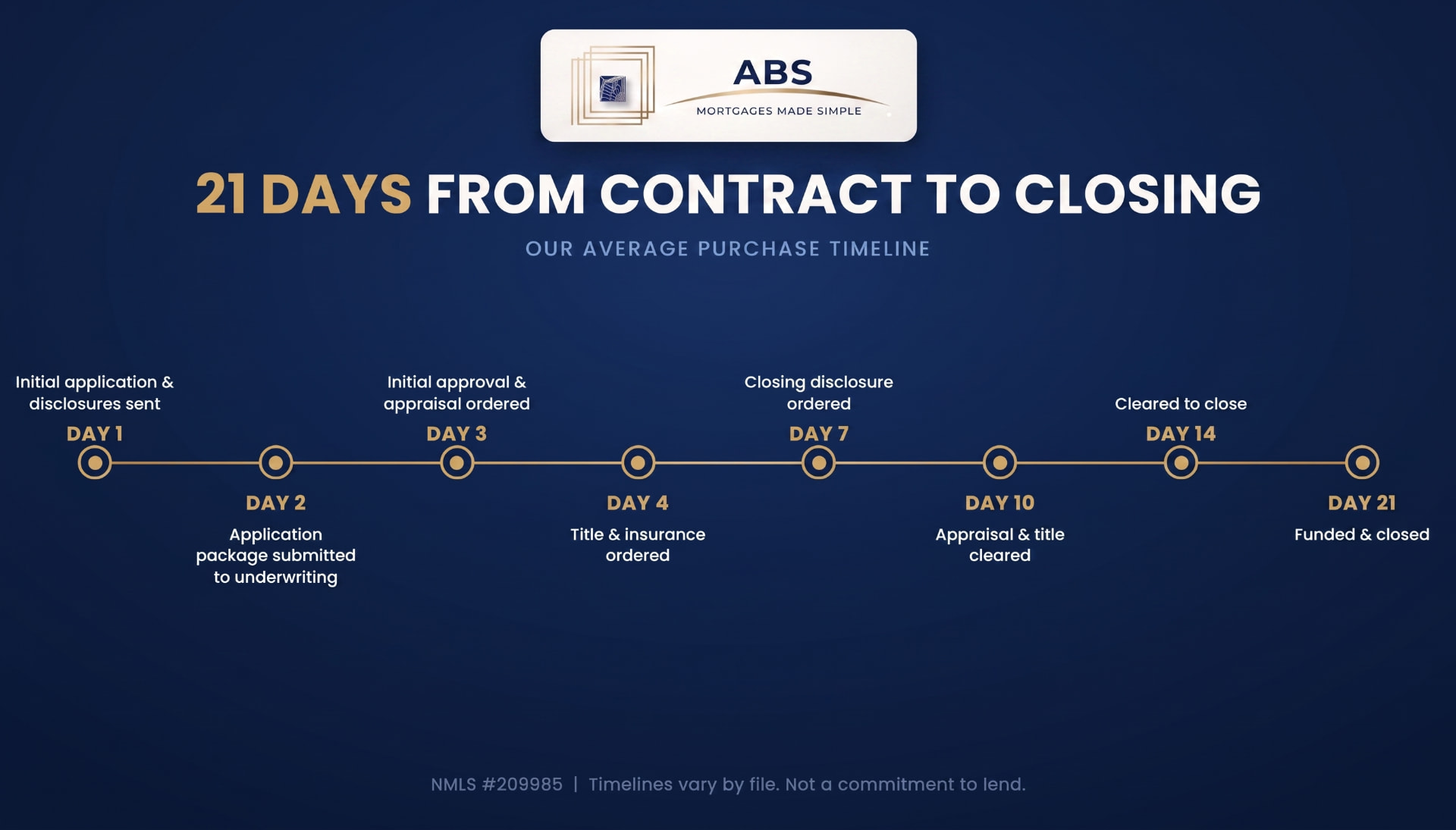
Twenty-one calendar days is our average purchase closing. Not our best case — our average. Clients ask us fairly often what actually happens during those three weeks, usually because a realtor told them "it depends" and they wanted a real answer.
Here it is. Not a marketing timeline with soft language like "processing" and "finalizing" — the actual sequence of work, day by day, and the specific points where a normal file slows down.
The 21 days at a glance
- Day 1 — Initial application and disclosures sent
- Day 2 — Full application package submitted to underwriting
- Day 3 — Initial approval issued; appraisal ordered
- Day 4 — Title work and insurance ordered
- Day 7 — Closing Disclosure requested from title
- Day 10 — Appraisal and title come back clear
- Day 14 — Cleared to close
- Day 21 — Funded and closed
That's the map. The rest of this post is what's actually happening at each of those points, and where a normal file slows down.
Week 1: Application Through Initial Approval (Days 1–4)
The clock starts the day you have a signed purchase contract and a complete application. Complete matters more than fast here — a partial application doesn't start a shorter clock, it starts the same clock later.
Day 1 is disclosures and document collection. We request your full document package (income, assets, ID, and anything specific to your loan program) and send your initial disclosures, which by law you have to receive within three business days of application — we send ours same-day rather than waiting for the deadline.
Day 2 is the submission deadline we hold ourselves to. Our goal is a fully packaged file to underwriting — not a partial file to "hold a spot in the queue." A partial submission comes back with a list of conditions that a complete one wouldn't have generated, and you lose the days you thought you saved.
Day 3, on a complete file, underwriting issues an initial approval with a short list of conditions — verification of employment, clarification on a deposit, something similar. The same day, we order the appraisal.
Day 4, title work and homeowner's insurance both get ordered: a search on the property for liens, judgments, unpaid taxes, or ownership issues, and a binder from your insurance carrier.
What slows this down
The single biggest week-one delay is documents trickling in over several days instead of arriving as a batch. Nine of eleven requested items doesn't get underwriting started on nine-elevenths of the file — it usually means underwriting doesn't start at all until the last two show up, which is what turns a Day 2 submission into a Day 6 submission. If your income doesn't fit neatly into a W-2 box — self-employment, 1099 income, bonus-heavy comp, rental income — the documentation list is longer and worth getting ahead of before Day 1. That's most of what non-QM lending exists to solve, and it's easier to solve on day one than a week in.
Week 2: Appraisal, Title, and Requesting the Closing Disclosure (Days 4–10)
This stretch is where most of the real waiting happens — not because anyone is slow, but because the appraisal and title work can't be rushed past a certain point.
The appraisal, ordered Day 3, gets scheduled, the property gets inspected, and the report comes back — typically landing by Day 10 on a standard file. This is the step with the least lender control. A standard single-family home in an active market moves faster than a unique property, a rural property, or anything requiring a second appraisal, which is common on some jumbo files.
Title work, ordered Day 4, runs in parallel and is usually clear by Day 10 as well. Most files come back clean. Some don't, and the ones that don't need time.
Day 7 is when we request your Closing Disclosure from title — not the version you'll sign off on, but a preliminary set of numbers so the real CD is ready to move the moment your file clears, instead of being built from scratch under deadline pressure. The disclosure that actually starts your mandatory review period goes out later, once every condition is cleared — more on that below.
What slows this down
Condo and HOA documentation is, in our experience, the single most common source of delay in this window — more than the appraisal, more than title. The lender needs the association's budget, insurance, reserve study, and litigation status, and the association sets its own timeline for producing them. We order these on Day 1 for exactly this reason, since a slow HOA can eat most of the Day 4-to-Day 10 window on its own. Beyond that: appraisals on unusual or high-value properties, title issues that surface on older properties (name mismatches, unreleased liens from a prior refinance), and large deposits into your bank account that don't have a paper trail yet. A $15,000 transfer with no explanation stops a file regardless of where it came from — gift funds, sale proceeds, and moving your own money between accounts are all fine, but all need to be documented before underwriting will count them.
Week 3: Cleared to Close and the Three-Day Window (Days 14–21)
Day 14 is clear to close, assuming the appraisal and title cleared on schedule around Day 10. What's left between those two points is clearing the conditions underwriting attached to your initial approval — verification of employment run a second time, closer to closing than the first, reserves confirmed, source of funds documented, insurance binder collected.
Once every condition clears, the Closing Disclosure goes out — the real one, built from the preliminary numbers requested back on Day 7. This is the step people are least prepared for: federal rules require you to receive it at least three business days before you sign. That window is fixed. It can't be shortened, waived, or expedited for any reason, which is why it functions as the real floor under any closing timeline, ours included, and why we start pulling numbers together on Day 7 instead of Day 14.
Those three days aren't dead time — final numbers go to the title company, wire instructions get confirmed (verbally, never by email alone, because wire fraud targeting real estate closings is real and it targets this exact step), and you do your final walkthrough. Then, on Day 21: signing, funding, and recording, in that order.
What slows this down
Anything that changes your credit or income profile after clear to close — a new car loan, a new credit card at the furniture store, a job change, a big purchase on an existing card — can trigger re-underwriting days before your closing date. Lenders re-verify employment and often re-pull credit close to signing specifically to catch this. The other common late delay is a rate lock that's about to expire before a closing date that's slipped for any other reason, which turns a small delay into a cost if it's not caught and extended in time.
Why 21 Days, Not Fewer
Our average includes normal files with normal friction: a borrower who needs three days to track down a document because they're traveling for work, an appraiser whose earliest opening runs a few days past the ideal date in a busy month, a condo association that takes the better part of a week to return a questionnaire nobody follows up on, a seller who needs a longer close because they're buying their own next home.
We've closed faster. We closed a $1.4 million jumbo loan in 12 calendar days for a client who needed to beat a competing offer. That required a borrower who returned every document within hours, a property that appraised cleanly on the first pass, and a title file with nothing in it. That's not a typical file, and we won't promise it to someone sight unseen just because it's happened before.
What we will tell you, on a call, before you sign anything, is what your specific file can realistically do — which loan program you're in changes the math, too, since conventional and FHA loans underwrite and appraise somewhat differently. That's a more useful number than a timeline printed on a flyer.
If Your File Is Running Behind Schedule
A few things actually move the needle if you're mid-process and worried about the date:
Answer document requests same-day, not same-week. The gap between "I'll get to it this weekend" and "I sent it in an hour" is routinely the difference between a Day 2 submission and a Day 6 submission — and everything downstream shifts with it.
Don't touch your credit or your bank accounts once you're under contract. No new credit lines, no large unexplained transfers, no changing jobs if you can help it. If something is going to happen — a bonus deposit, a gift from a family member — tell your loan officer before it happens, not after underwriting flags it.
Ask for a straight answer on your closing date, not a reassuring one. If your lender can't tell you which condition is outstanding and who's waiting on what, ask them to find out. You're entitled to know exactly what's holding your file up at any point in the process, and a lender with direct access to underwriting should be able to tell you that in a phone call, not a form email.
Common questions
How long does a mortgage typically take to close?
Our average purchase closing is 21 calendar days. Nationally, Rocket Mortgage's own data put the average purchase closing timeline at 42 days in 2025, and most industry guidance quotes a 30-to-60-day range. The gap comes down to how fast a complete file reaches underwriting — we aim for Day 2, not the end of week one.
What is the single biggest cause of closing delays?
In our experience, it's incomplete document packages in the first few days and condo or HOA documentation in the appraisal-and-title window that follows. Both are avoidable — the first by sending everything requested at once instead of piecemeal, the second by ordering association documents on Day 1 instead of waiting for underwriting to ask for them.
Can a mortgage close faster than 21 days?
Yes, in the right circumstances. We've closed in as few as 12 calendar days when a borrower returns documents immediately, the appraisal comes back clean on the first try, and title turns up nothing to clear. The federal three-business-day Closing Disclosure waiting period sets a practical floor under any purchase closing, fast or not.
Why does the Closing Disclosure have to go out three days before signing?
It's a federal requirement (part of the TRID rule) meant to give borrowers time to review their final loan terms and costs before committing. We request preliminary numbers from title around Day 7 so the disclosure is ready to issue the moment your file clears, but the countdown itself starts when you actually receive it, and it cannot be shortened or waived — which is why it's the fixed point every closing timeline gets built around.
What should I do if I'm buying in a competitive, multiple-offer market?
Get underwritten, not just pre-approved, before you're competing on an offer — an underwritten approval means your income and assets are already reviewed by the person making the decision, which is what lets a lender credibly commit to a shorter timeline. And never waive a financing contingency or agree to a non-refundable deposit without a direct conversation with your loan officer first about what your specific file can do.
Closing timelines vary by file, property type, loan program and third-party turn times. No specific closing timeline is guaranteed, and details referenced above have been generalized. Rates, terms, and programs are subject to change without notice, and all loans are subject to credit approval.
Follow us on Google: Add ABS Home Mortgage as a preferred source
Related Reading
We Closed a $1.4 Million Jumbo in 12 Calendar Days
A Chicago-area buyer won a multiple-offer bid by agreeing to a non-refundable deposit and a 12-day close. Here's the day-by-day of how the file closed on time.
Read articleFirst-Time Home Buyer Guide: Naperville 2026
What you can actually afford with DuPage County taxes, down payment minimums, neighborhood pricing by ZIP, Illinois assistance programs, and the pre-approval process.
Read articleDoes Shopping Multiple Mortgage Lenders Hurt Your Credit? Reddit Says 14, 30 or 45 Days. Here's Which One Applies
The 14-, 30- and 45-day credit inquiry windows explained, plus the 2026 trigger-lead rules.
Read articleUAD 3.6: The New Appraisal Format
What appraisers must report now, the Nov. 2 mandate, and what it means for timing.
Read articleMore in First-Time Buyer · All mortgage guides