How to Improve Your Credit Score Before a Mortgage, and What VantageScore 4.0 Changes

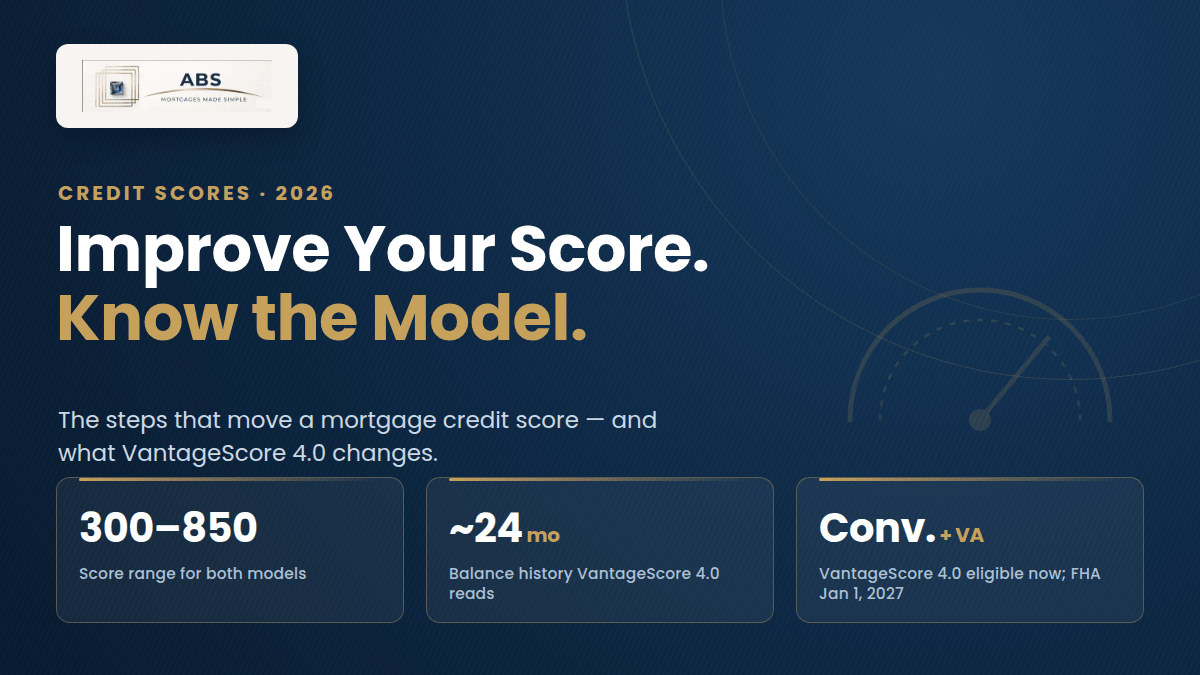
For decades, one question decided the credit side of a mortgage: what is your Classic FICO score? That is no longer the only possible answer. As of September 2026, lenders that sell loans to Fannie Mae and Freddie Mac can use VantageScore 4.0 instead of Classic FICO. It doesn't change the basics of how to build a good score. It does change a few details worth knowing before you apply.
The short version:
- Paying on time and keeping card balances low still do most of the work, under either model.
- VantageScore 4.0 looks at how your balances move over time, and can count rent and utility payments when they're reported.
- VantageScore 4.0 is now an eligible score on conventional and VA loans. FHA follows on January 1, 2027.
- The lender chooses which model to use, loan by loan. You can't choose it yourself.
- Rocket Mortgage said its testing found VantageScore 4.0 let more clients meet credit requirements. Among borrowers who saved money with it, the average savings was $1,600 at closing.
- Neither model guarantees approval or a lower rate.
What changed with VantageScore 4.0
Fannie Mae and Freddie Mac began accepting VantageScore 4.0 from a limited group of lenders in April 2026. On September 9, 2026, they opened it to all approved lenders. Lenders can still use Classic FICO, and many will for now. Adoption is optional, and it takes time for lenders, software and mortgage insurers to update.
A few practical points:
- The lender picks the model, and it can differ from one loan to the next. The same model has to be used for every borrower on the loan.
- Credit reports haven't changed. Lenders still pull reports from all three bureaus, and the middle score is typically the one that counts. Regulators have said they are looking at fewer reports, but nothing is final.
- By loan type: As of October 1, 2026, VantageScore 4.0 is eligible on conventional and VA loans. FHA is on a slightly later schedule: starting January 1, 2027, lenders may use VantageScore 4.0, FICO 10T or Classic FICO on most FHA loans.
What Rocket Mortgage's testing found
On September 28, 2026, Rocket Mortgage said it had obtained 1.4 million credit reports using both VantageScore and FICO so far this year. Its testing found that VantageScore 4.0 allowed more clients to meet credit requirements and move forward in the mortgage process. Among borrowers who saved money when evaluated using VantageScore 4.0, Rocket said the average savings was $1,600 at closing.
Rocket is making VantageScore 4.0 its default in the fourth quarter of 2026 for eligible loans it makes directly to consumers, such as conventional and VA loans. FHA, jumbo, investment property, second home and home equity loans still use FICO for now. Its broker division, Rocket Pro, said it will provide both VantageScore and FICO to mortgage brokers.
Two things to keep in mind. These are Rocket's own results across its clients, and the $1,600 average applies only to the borrowers who saved money. It isn't a figure every buyer should expect, and some borrowers score lower under VantageScore 4.0 than under FICO. Credit is also only one part of an approval: income, debt, assets and the property all count too.
How VantageScore 4.0 differs from Classic FICO
Both models use a 300 to 850 scale and look at the same basics: payment history, how much of your credit you use, how long you've had credit, and new accounts. The differences that matter for buyers:
Trended data. VantageScore 4.0 looks at your behavior over roughly the last 24 months, not just a snapshot. A card you pay off each month looks different from one that carries a balance and a minimum payment, even if the balance on statement day is the same.
Rent and utility payments. VantageScore 4.0 can count them. The catch is that most rent never reaches the bureaus. A TransUnion survey found 13% of consumers had rent reported in 2025. If your landlord or property manager doesn't report it, it won't help.
Thinner credit files. For someone with few accounts, the extra data can matter. Zillow's analysis of 2025 mortgage data found about a third of conventional purchase denials were due to a lack of credit history.
What it does not do is guarantee a higher score. It can come out higher or lower than your FICO. Not everyone benefits, and a late rent payment that is reported can hurt.
How to improve your credit score before applying
These steps work under either model. In rough order of impact:
1. Pay every bill on time, every time. Payment history is the largest factor in both models. A single 30-day late payment can cost real points and stays on your report for years. If you're behind on anything, get current first.
2. Bring card balances down, and keep them down. Use is judged against your limits, and lower is better. Because VantageScore 4.0 looks at a trend, paying a card down once and then running it back up before you apply won't show you in your best light. Pay balances down, then keep them there for a few months.
3. Keep old accounts open. Closing a card you've had for years can shorten your credit history and cut your available credit, which can raise your use ratio. If it has no annual fee, leave it open and use it for something small now and then.
4. Check your reports for errors. You can get free reports from all three bureaus at annualcreditreport.com. Look for accounts that aren't yours, balances that are wrong, and payments marked late that weren't. Dispute errors in writing with the bureau, and give it time. Disputes aren't instant.
5. Don't open new credit while you're in the process. A new card or a car loan changes your debt-to-income ratio and can move your score right when the lender is looking. Wait until after closing.
6. Shop lenders in a tight window. Credit pulls from multiple mortgage lenders for the same loan are treated as one inquiry if they fall in a short window. We wrote about how that works and which window applies.
7. Think before paying off collections. Paying one off is the right thing to do, but depending on the scoring model it doesn't always raise your score, and some loan programs have their own rules for them. Ask before you send money.
8. Be careful with rent reporting. It can help if your rent is always on time and the service reports to all three bureaus. It can hurt if you're ever late. Check which bureaus a service reports to before you pay a fee.
If you're new to the U.S. and starting from nothing, this guide to building credit as a new arrival covers the first steps.
What score do you need?
It depends on the loan program, and lenders and investors often set higher minimums than the program does. As of October 1, 2026, and subject to change: conventional loans generally start at a 620 score, and FHA loans allow 3.5% down at 580. You can read more in how FHA loans work. Score also affects price. The bigger gains usually come from crossing a pricing tier, not from small moves inside one. To see which programs fit your score, browse our loan programs.
How we can help you build a plan
If your score is close to a cutoff, or you are a few months from buying, a plan usually beats guessing. It starts with an application at the pre-approval stage, before you shop for a home, so we have your actual credit report in front of us. Here is what we do with it:
- Read your reports with you. We look at what is actually holding the score down: card balances, a late payment, a collection, a thin file or an error.
- Rank the fixes by effect. Some steps move a score within a billing cycle or two, and others take months. We'll tell you which is which, so you don't spend money on something that won't matter for your loan.
- Tie it to your loan. We show you where your score sits against the program minimums and the pricing tiers, so you can see what a higher score could change: whether you qualify, and what the rate and costs might look like.
- Set a timeline and a recheck. We agree on what to do first and when to look again, so you aren't waiting until the full application to find out where you stand.
- Use a rapid rescore when it applies. After you pay down a balance or an error is corrected, a lender can sometimes ask the credit bureaus for an updated score faster than the normal reporting cycle. Not every file qualifies, and it isn't worth it on every file.
A better score can help you qualify for a program, lower your mortgage insurance cost or improve your rate. It is not a promise of any of those. If waiting wouldn't change your numbers, we'll say so, and we move forward with what you have.
Which score will my lender use?
It depends on the loan program, the investor and the lender's systems. VantageScore 4.0 is eligible on conventional and VA loans today, with FHA to follow in January 2027, but eligible doesn't mean it's the better choice on every file. When you apply, ask which model is being used and whether another model is available. We tell clients which one applies to their file, and what the score means for their rate, before they decide anything. Many free credit apps show a VantageScore, which is often a different version from the one used in mortgage underwriting. Treat it as a guide, not your mortgage score.
Common questions
Can you help me make a plan to improve my score before I buy?
Yes, and the best time to do it is at the pre-approval stage, before you start making offers. You do still need to apply, because we need your application and credit report to see what is actually holding your score down. From there we review your credit with you and put the steps in order with a rough timeline. We tie the plan to your loan, so you know what a higher score could change: qualifying, your down payment or mortgage insurance, or your pricing. It can improve your options, but we can't promise a particular score, approval or rate. If your numbers are fine as they are, we'll tell you that too.
Will VantageScore 4.0 raise my score?
Not necessarily. It can be higher or lower than your Classic FICO score. Rocket Mortgage's testing found more of its clients met credit requirements with VantageScore 4.0, but results vary by borrower. People with thin files, steady reported rent or a history of paying cards in full may see a better result. People with high balances carried month to month may not.
Can I choose which score my lender uses?
No. The lender chooses, and it can vary by loan. You can ask which model they're using.
Can I check my VantageScore 4.0 myself?
It isn't easy. Some free apps show other VantageScore versions. A lender or broker can usually see the one that applies when they pull your credit.
How long does it take to improve a credit score?
It depends on what's holding the score down. Paying down balances can show up within a billing cycle or two. Late payments and collections take much longer. We'd rather look at your actual report than guess.
Does improving my score guarantee a better rate?
No. Rates depend on the market, the loan program, your down payment, income and more. A higher score can move you into a better pricing tier, but it doesn't guarantee approval or any particular rate.
Wondering where you stand? Apply for pre-approval or send us your situation, and we'll build a plan together: which steps will move the needle for your loan, and which ones won't. Call Bhupesh directly at 630-301-8823, the office at 630-357-1600, or email bsaggar@absmtg.com. We'll look at your numbers before you start paying anything down or closing anything out.
Information is as of October 4, 2026 and is subject to change without notice. Credit scoring models, lender and investor requirements, and program minimums vary and may change. VantageScore 4.0 eligibility is by loan program (conventional and VA as of this date; FHA expected January 1, 2027), and which scoring model applies to a loan is determined by the lender and investor. This article is general information, not credit repair, financial, tax or legal advice, and not a guarantee of any score, approval or rate. This is not a commitment to lend. All loans are subject to credit approval.
Sources: FHFA, Credit Scores; Fannie Mae, Credit Score Models and Reports Initiative; Freddie Mac, Credit Score Models and Reports Initiative; Rocket Companies, Rocket Mortgage Becomes First Home Lender to Use VantageScore as its Preferred Scoring Model on All Eligible Loans, Sept. 28, 2026.
Follow us on Google: Add ABS Home Mortgage as a preferred source
Related Reading
Does Shopping Multiple Mortgage Lenders Hurt Your Credit? Reddit Says 14, 30 or 45 Days. Here's Which One Applies
The 14-, 30- and 45-day credit inquiry windows explained, plus the 2026 trigger-lead rules.
Read articleHow to Build U.S. Credit Fast as a New Arrival (So You Can Buy a Home Sooner)
How newcomers build a credit file lenders can approve, typically in 12 to 24 months.
Read articleFHA Loans in 2026: What 3.5% Down Actually Costs You
Credit score minimums, 2026 loan limits, how long mortgage insurance really lasts, gift funds, seller credits, and when conventional costs less.
Read articleMore in First-Time Buyer · All mortgage guides