FHA Loans in 2026: What 3.5% Down Actually Costs You

Most people's idea of an FHA loan is "the low-credit-score option." That's true, but it's not the whole picture, and it's not even the most useful way to think about it.
Here's the better frame: FHA is a government-backed loan that trades a lower bar to qualify for a mortgage insurance cost that, in the most common case, never goes away. Whether that trade is worth it depends entirely on your numbers — and most of the articles on this topic don't walk you through the actual math.
What an FHA loan actually is
FHA doesn't lend you money. The Federal Housing Administration insures the loan a private lender makes to you, which means the lender takes on less risk and can approve borrowers a conventional loan would turn away — lower credit scores, higher debt-to-income ratios, thinner savings. It's the most-used entry point for first-time buyers in the country, and it's been around since 1934.
That government backing is not free. You pay for it, in two pieces, for as long as you have the loan or until you refinance out of it. That cost — not the down payment, not the credit score — is the detail that actually decides whether FHA is the right tool for your file.
The down payment and credit score
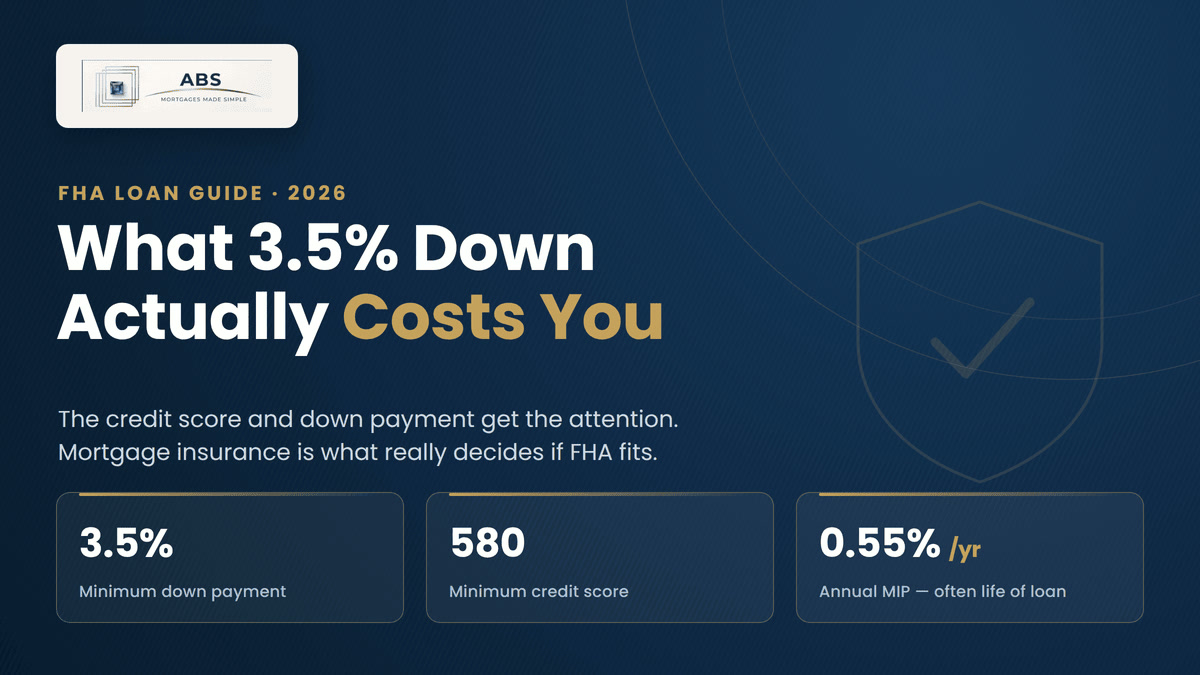
FHA's minimum down payment is 3.5%, available to borrowers with a credit score of 580 or higher. Below that, down to a 500 score, FHA still works, but the minimum down payment jumps to 10%.
A few things worth knowing about that 580 number: it's HUD's floor, not a guarantee. Most lenders apply their own overlay on top of it, commonly somewhere in the 600–640 range, because they're the ones holding the loan until it's sold and want a cushion. If you're told 580 isn't enough at one shop, that's the lender's rule, not FHA's — worth a second opinion before you assume you don't qualify anywhere.
The 3.5% down can come from your own savings, but it doesn't have to. FHA allows the entire down payment to be a gift — from family, and in some cases from an employer, union, charity, or government program — as long as it's documented in writing, signed and dated by the donor, with no expectation of repayment. If your credit isn't quite there yet, building it up first is often faster than people expect.
What the mortgage insurance actually costs
This is the part that decides everything else, so I'll be specific.
FHA charges an upfront mortgage insurance premium (UFMIP) of 1.75% of your base loan amount. Almost nobody pays this in cash — it's typically rolled into the loan balance, so on a $400,000 loan you're financing roughly $7,000 more than the purchase price.
Then there's an annual premium, paid monthly, that runs 0.55% of the loan balance at the standard 3.5%-down tier, or 0.50% if you put down 10% or more. On a $400,000 loan at the 3.5%-down tier, that's roughly $183 a month, before principal, interest, taxes, or homeowners insurance.
Here's the part that surprises people. Whether that monthly premium ever goes away depends on your down payment, not your payment history:
- Put down 10% or more, and annual MIP drops off automatically after 11 years.
- Put down less than 10% — which includes the standard 3.5%-down purchase — and MIP stays for the life of the loan. Not until you hit 20% equity. Not until your home appreciates. For the full term, however long that is.
Compare that to a conventional loan's private mortgage insurance, which cancels automatically once your balance hits 78% of the original value and can be requested at 80%. That's the real difference between the two loan types, and it's worth more of your attention than the credit score minimum. We break down that full comparison, state by state, in our guides for Illinois, Florida, Georgia, and Texas.
One more thing worth knowing going in: choosing FHA now doesn't lock you into life-of-loan MIP forever. Once your credit improves or your equity grows, refinancing into a conventional loan is the standard way borrowers get out of it — and if you keep your upfront costs low on the way in, a no-closing-cost refinance leaves nothing to earn back if that move comes sooner than planned.
FHA loan limits for 2026
FHA won't insure a loan above a set ceiling, and that ceiling moves with local home prices. For 2026, the national floor is $541,287 for a one-unit property, and the ceiling in the highest-cost markets is $1,249,125. Where your county falls in that range depends entirely on local home values — HUD recalculates every county's limit annually based on median sale prices.
This matters more than people expect. In a county at the floor, an FHA loan above roughly $541,000 simply isn't available — not harder to get, not more expensive, unavailable. You'd be looking at conventional or jumbo financing instead. In a high-cost county, FHA can reach over $1.2 million. The exact number for your county is the number that matters, which is why we've written county- and state-specific breakdowns for Illinois, Florida, Georgia, and Texas rather than quoting one national number as if it applied everywhere.
Debt-to-income, and how forgiving FHA really is
FHA's standard guideline caps your front-end ratio (housing costs alone) at 31% of gross income and your back-end ratio (all debts, including the new mortgage) at 43%. In practice, most FHA lenders will go well past that — up to 50% back-end or higher — for borrowers with strong credit, reserves, or other compensating factors like a low housing-payment increase or significant residual income.
That flexibility is one of FHA's real advantages over conventional financing, particularly for buyers carrying student loans, a car payment, or credit card balances alongside a mortgage application. It's also one of the reasons FHA remains the more forgiving option after a bankruptcy, foreclosure, or collection account — FHA's seasoning requirements after a credit event are typically shorter than conventional's, and its underwriting has more room for a documented explanation.
Seller concessions and closing costs
Sellers can contribute up to 6% of the purchase price toward your closing costs, prepaid items, and discount points on an FHA loan — one of the more generous concession limits across loan types. In a buyer's market, or in a negotiation where the seller has room, that 6% can cover most or all of your out-of-pocket cash to close, on top of a gifted down payment. It cannot be used to reduce your down payment itself.
The property has to qualify too
FHA underwrites the home, not just you. Every FHA purchase requires an FHA appraisal, which checks value the same way any appraisal does but also confirms the property meets HUD's minimum property requirements (MPRs) — a functioning roof, heat, and water; no exposed wiring or safety hazards; no peeling paint in homes built before 1978. It's a livability standard, not a cosmetic one, but it does mean a true fixer-upper often can't close as a standard FHA purchase. (If you're set on a property that needs real work, an FHA 203(k) renovation loan wraps the purchase and the repair costs into one loan — a different product from the standard FHA loan this guide covers, and one we'll walk through in more detail in a future post.)
Two more property rules worth knowing: the home has to be your primary residence, occupied within 60 days of closing — FHA isn't available for second homes or investment property. And FHA generally won't insure a purchase where the seller acquired the property fewer than 90 days before your contract date, a rule aimed at flipped properties, with limited exceptions for documented renovation work.
Who FHA is actually built for
Pulling that together, FHA tends to be the right call when:
- Your credit score is below 620, where conventional financing typically isn't available or isn't priced competitively.
- You're carrying higher debt-to-income than conventional guidelines allow.
- You've had a recent credit event — a bankruptcy, foreclosure, or collection account — that's since been resolved.
- Your down payment savings are thin, and gift funds or a lower minimum matter to getting you into a home sooner rather than later.
And conventional tends to win once your credit is comfortably above 680 and you have at least a little down payment flexibility, because the mortgage insurance is cheaper, priced to your credit, and it ends.
One eligibility rule that's newer and catches people off guard: as of May 25, 2025 (HUD Mortgagee Letter 2025-09), FHA is no longer available to non-permanent residents — H-1B, L-1, and similar work-visa holders. Lawful permanent residents remain eligible on the same terms as citizens. If you're a visa holder, conventional financing is the applicable agency option, not a fallback — we cover how that works in our H-1B and NRI mortgage guide.
If your income doesn't fit neatly into either box — you're self-employed, or your tax returns understate what you actually make — it's worth knowing FHA and conventional aren't the only two doors. Non-QM loans use bank statements or assets instead of tax returns, and they solve a different problem than FHA does.
How to actually get started
The application itself works the same way any mortgage does: full documentation of income, assets, and debts, a credit pull, and an appraisal once you're under contract. What differs with FHA is mainly the underwriting tolerance described above, and the mortgage insurance calculation. If you're a first-time buyer weighing FHA against your other options in the Naperville area, our first-time buyer guide walks through the fuller picture, including down payment assistance that layers on top of FHA in Illinois. For the full breakdown of down payment tiers, mortgage insurance costs, and 2026 loan limits in one place, see our FHA loan program page.
The honest answer to "is FHA right for me" is that it depends on numbers I can't see from a blog post — your score, your debts, your county's loan limit, your actual purchase price. That comparison takes one phone call, not a guess.
Common questions
What credit score do I need for an FHA loan?
580 to put down the standard 3.5%. Between 500 and 579, FHA still works, but the minimum down payment rises to 10%. Many individual lenders set their own minimum higher than HUD's floor, commonly in the 600–640 range.
Does FHA mortgage insurance ever go away?
Only if you put down 10% or more, in which case the annual premium ends after 11 years. Below 10% down — including the standard 3.5%-down purchase — annual MIP lasts for the full loan term. Refinancing into a conventional loan is how most borrowers eliminate it early.
What's the FHA loan limit for 2026?
The national floor is $541,287 for a one-unit home, and the ceiling in the highest-cost counties is $1,249,125. Your county's actual limit falls somewhere in that range based on local home values — check our state-specific guides for the exact number where you're buying.
Can I use gift funds for my FHA down payment?
Yes, the entire 3.5% (or 10%) down payment can come from a gift, typically from a family member, as long as it's documented with a signed gift letter and there's no expectation of repayment.
How much can a seller contribute toward my closing costs on an FHA loan?
Up to 6% of the purchase price toward closing costs, prepaid items, and discount points. It cannot be applied toward your required down payment.
Can I buy a fixer-upper with an FHA loan?
A standard FHA loan requires the home to meet HUD's minimum property requirements — functioning systems, no safety hazards — so a home needing significant work usually won't qualify as-is. The FHA 203(k) loan is a separate program built specifically to finance the purchase and the renovation together.
Is FHA available to visa holders?
Not anymore for non-permanent residents. HUD Mortgagee Letter 2025-09 removed FHA eligibility for borrowers on temporary work visas, effective for case numbers assigned on or after May 25, 2025. Lawful permanent residents are still eligible on the same terms as U.S. citizens.
Can I use an FHA loan for a rental property?
No. FHA requires the home to be your primary residence, occupied within 60 days of closing. Second homes and investment properties don't qualify.
Is FHA or conventional the better loan?
It depends mainly on your credit score and down payment. Below roughly 620, FHA is usually the more available and more forgiving option. Above roughly 680 with some down payment flexibility, conventional usually costs less overall because its mortgage insurance is priced to your credit and cancels. Between those two, it's worth pricing both.
Want to know which side of that line you're on? See our FHA loan program or call 630-357-1600, reach me directly at 630-301-8823, or email bsaggar@absmtg.com. I'll price both FHA and conventional against your actual numbers so the decision is based on math, not a rule of thumb.
Figures are current as of September 2026 and are subject to change. FHA loan limits are set annually by HUD and vary by county; mortgage insurance premiums, credit score minimums, and debt-to-income guidelines are set by HUD, and individual lenders may apply stricter overlays than the agency minimums shown here. This article is general information, not financial, tax, or legal advice.
Follow us on Google: Add ABS Home Mortgage as a preferred source
Related Reading
FHA vs. Conventional in Illinois (2026)
Illinois FHA and conforming loan limits, how long mortgage insurance actually lasts on each loan type, and IHDA down payment assistance.
Read articleFHA vs. Conventional in Florida (2026)
How Florida's county-by-county loan limits swing by over $400,000, plus FL Assist and Florida Hometown Heroes down payment assistance.
Read articleFHA vs. Conventional in Georgia (2026)
Why the metro-Atlanta county line changes your FHA limit by nearly $180,000, plus Georgia Dream down payment assistance.
Read articleFHA vs. Conventional in Texas (2026)
Why Texas's metro FHA limits vary by up to $275,000 by county, and what no state income tax really does to your mortgage math.
Read articleFirst-Time Home Buyer Guide: Naperville 2026
What you can actually afford with DuPage County taxes, down payment minimums, neighborhood pricing by ZIP, Illinois assistance programs, and the pre-approval process.
Read articleHow to Improve Your Credit Score Before a Mortgage, and What VantageScore 4.0 Changes
The steps that actually move your score before you apply, and what VantageScore 4.0 does and doesn't change.
Read article2026 and 2027 Conventional Loan Limits: What Qualifies Now
The 2026 baseline conventional loan limit is $832,750 for a one-unit home. ABS Home Mortgage is already using the higher 2027 numbers to close loans now, up to $850,000, ahead of FHFA's official November announcement.
Read articleMore in First-Time Buyer · All mortgage guides