No Closing Cost Refinance: Why It Matters Most If Rates Drop Again

Here is a situation I have watched play out more than once.
A homeowner refinances. They pay around $6,000 in closing costs to get the lower rate, and the math looks fine on paper — the payment drops enough to earn that money back in about three and a half years. Then rates move again ten months later. Now there is a better rate available, and they are sitting on $5,000 of costs they never recovered, deciding whether to spend money a second time to chase it.
That is the problem a no closing cost refinance is built to solve.
What it actually means
On a no closing cost refinance, we cover the closing costs associated with the loan. That means the fees required to originate and close it — underwriting, processing, the appraisal, title work, recording fees, and the rest of the line items that normally add up to several thousand dollars.
You do not write a check for them, and they do not get added to your loan balance either. That second part matters. Rolling costs into the balance is often described as "no cost," but it is not — you financed them, you are paying interest on them for the life of the loan, and your balance went up.
What it does not cover
It covers costs. It does not cover prepaids.
Prepaids are not fees, and this distinction trips people up. Your escrow account for property taxes and homeowners insurance is your own money, sitting in an account held for your benefit. Same with the per-diem interest between closing and your first payment — that is interest for days you actually had the loan. Nobody is charging you for those; you are funding your own obligations.
So on a no closing cost refinance you will still fund escrow at closing. What softens it is that your existing lender refunds the balance sitting in your old escrow account, typically within about 30 days of payoff. For most borrowers the refund roughly offsets the new deposit — it just does not arrive on the same day, so plan for the gap.
I would rather tell you that up front than have you find it on a Closing Disclosure.
Nothing is free, and here is the honest version
A no closing cost structure is not a discount. The rate on a no cost loan is generally somewhat higher than the rate you could get if you paid the costs out of pocket. That is the trade.
Whether the trade is good depends entirely on one thing: how long you actually keep the loan.
If you pay costs, you are buying a lower rate and you need time to earn that purchase back. If you do not pay costs, you take a slightly higher rate and you owe nothing to recover. The longer you hold the loan, the more the first option wins. The shorter you hold it, the more the second one does.
Most people badly overestimate how long they will keep a mortgage.
The advantage nobody talks about: you can do it again
Run the break-even honestly.
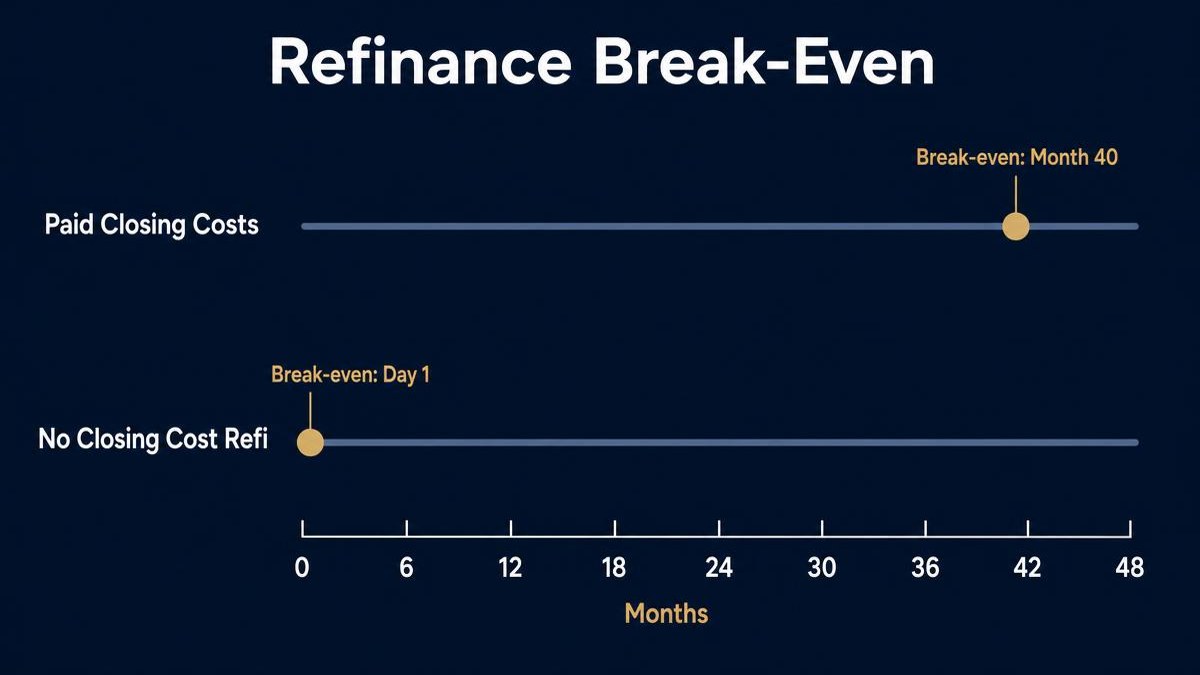
Say a refinance costs $6,000 and saves you $150 a month. Your break-even is 40 months. That is the point where you are ahead. Before that point, you are behind.
Now ask a harder question: what are the odds you still have that exact loan 40 months from now? If rates drop meaningfully next year, you would want to refinance again — and you should. But doing it means walking away from the costs you have not recovered yet, and paying a fresh set on the new loan.
With a no closing cost refinance there is nothing to recover. You are at break-even from day one. If a better rate shows up in eight months, you are free to take it, and you have not lost anything by having refinanced in the meantime.
That is the real argument, and it has nothing to do with predicting rates. I do not know where rates are going, and neither does anyone quoting you a forecast. What I know is that a loan with no sunk cost attached to it leaves you free to move when something better appears. In an environment where rates could keep moving, optionality is worth something.
The best refinance is often the one you can afford to do twice.
When paying the costs is the better call
I am not going to pretend this is right for everyone.
If you are confident you are staying in the home and keeping this loan for many years — you are not moving, you are not paying it off early, you do not expect to refinance again — then paying costs to secure the lower rate will usually come out ahead over a long enough horizon. The break-even arrives, and everything after it is yours.
If you are near the end of a loan term, or you are planning to sell in a few years, or you think there is a real chance you refinance again, the no cost structure is usually the better fit.
The right answer depends on your horizon, not on which option sounds better in an ad. Ask any lender to show you both — the cost version and the no cost version, side by side, on your actual loan amount. If they will not, that tells you something. This is the same reason I tell people to stop waiting for the perfect rate and start working with the numbers actually in front of them.
What determines whether you qualify
Many factors go into whether a no closing cost refinance is available on your file, and how much of the cost we can absorb. The main ones:
Loan size
The most important single factor. The credit available to offset costs scales with the loan amount, while a lot of closing costs are close to fixed no matter the loan size. A larger loan generates enough to absorb them comfortably. On a small balance, the same fixed costs are much harder to cover, and sometimes cannot be covered in full.
Credit score
Your score drives your pricing, and your pricing determines how much room there is to work with. A stronger credit profile leaves more flexibility. If your score has improved since you took out your current mortgage, that helps here in a way most people do not expect.
Loan-to-value
How much equity you have affects pricing the same way. Lower leverage generally prices better and creates more room. If you are close to a threshold — and the common ones sit at 80%, 75% and 60% — it is worth knowing before you start, because moving across one can change the answer.
Loan product
Conventional, jumbo, FHA, VA and non-QM all price differently, and they do not all leave the same room to cover costs. A structure that works easily on one product may not be available on another. If your income is documented outside a standard W-2 — self-employment, bonus-heavy pay, rental income — non-QM options have their own pricing, and the answer there is different again.
Jurisdiction
Where the property sits matters more than people expect, because the closing costs themselves vary by state and county. Recording fees, title practice, and state mortgage taxes are not the same in Illinois, Florida, Georgia and Texas. Higher fixed costs are simply harder to absorb.
Texas adds its own wrinkle: on a Texas cash-out refinance under Section 50(a)(6), lender-controlled fees are capped at 2% of the loan amount, with most third-party charges excluded from that cap. It is a rule worth understanding before you plan around it.
We lend in all four states, and the answer genuinely differs between them.
Common questions
What is a no closing cost refinance?
It is a refinance where the lender covers the closing costs associated with the loan — underwriting, processing, appraisal, title and recording fees — rather than the borrower paying them at closing or adding them to the loan balance. The trade-off is a somewhat higher interest rate than the same loan would carry if the costs were paid out of pocket.
Is a no closing cost refinance really free?
No, and any lender telling you it is has skipped a step. The costs are covered through your pricing rather than eliminated. It is a genuine benefit when you do not expect to hold the loan long enough to recover the costs you would otherwise pay, and a worse deal if you keep the loan for many years.
Do I still need money at closing?
Usually some. Closing costs are covered, but prepaid items are not — you will still fund your escrow account for taxes and insurance and pay interest for the days between closing and your first payment. Your existing lender refunds your old escrow balance, generally within about 30 days after payoff, which typically offsets much of it.
Can I refinance again later if rates drop?
That is the main reason to consider this structure. Because there are no closing costs to recoup, you are not waiting to reach a break-even point before another refinance makes sense. Whether you qualify at that time depends on your credit, equity, income and the pricing available then — but you would not be carrying sunk costs from this loan into that decision.
How do I find out if I qualify?
Call us. Whether a no closing cost refinance is available on your file, and how much of the cost we can cover, depends on your loan size, credit score, loan-to-value, loan product and the state your property is in. It takes a short conversation and a look at your numbers to give you a real answer instead of a maybe.
Want to know what your file can do? Call 630-357-1600, reach me directly at 630-301-8823, or email bsaggar@absmtg.com. Ask for both versions — with costs and without — and we will show you the break-even on your actual numbers so you can decide for yourself.
Availability of a no closing cost structure and the amount of closing costs that can be covered vary by loan size, credit profile, loan-to-value, loan program, occupancy, property type and state, and are subject to change without notice. Not all borrowers or properties will qualify. Examples shown are illustrative only and do not reflect an offer of specific terms, rates or fees. Prepaid items, including escrow deposits and per-diem interest, are not closing costs and remain the borrower's responsibility. Escrow refund timing is set by your existing servicer. This article is general information, not financial or legal advice.
Follow us on Google: Add ABS Home Mortgage as a preferred source
Related Reading
The Fed Raised Rates Again. Here's What Actually Helps Your Payment Right Now
Why a quarter-point Fed hike doesn't map directly onto your mortgage rate, and how discount points and 1-0, 2-1, and 3-2-1 temporary buydowns actually work.
Read articleStop Waiting for the 'Perfect' Rate: A Smarter Way to Buy a Home in 2026
Waiting for mortgage rates to plunge has quietly become one of the most expensive mistakes a homebuyer can make. Here's what today's market actually looks like.
Read articleWe Closed a $1.4 Million Jumbo in 12 Calendar Days
A Chicago-area buyer won a multiple-offer bid by agreeing to a non-refundable deposit and a 12-day close. Here's the day-by-day of how the file closed on time.
Read articleReverse Mortgages in 2026: What a HECM Actually Costs You
A plain-language look at HECM costs, mortgage insurance, interest, equity, repayment, and the obligations homeowners keep.
Read articleMore in Refinance · All mortgage guides