The Fed Raised Rates Again. Here's What Actually Helps Your Payment Right Now

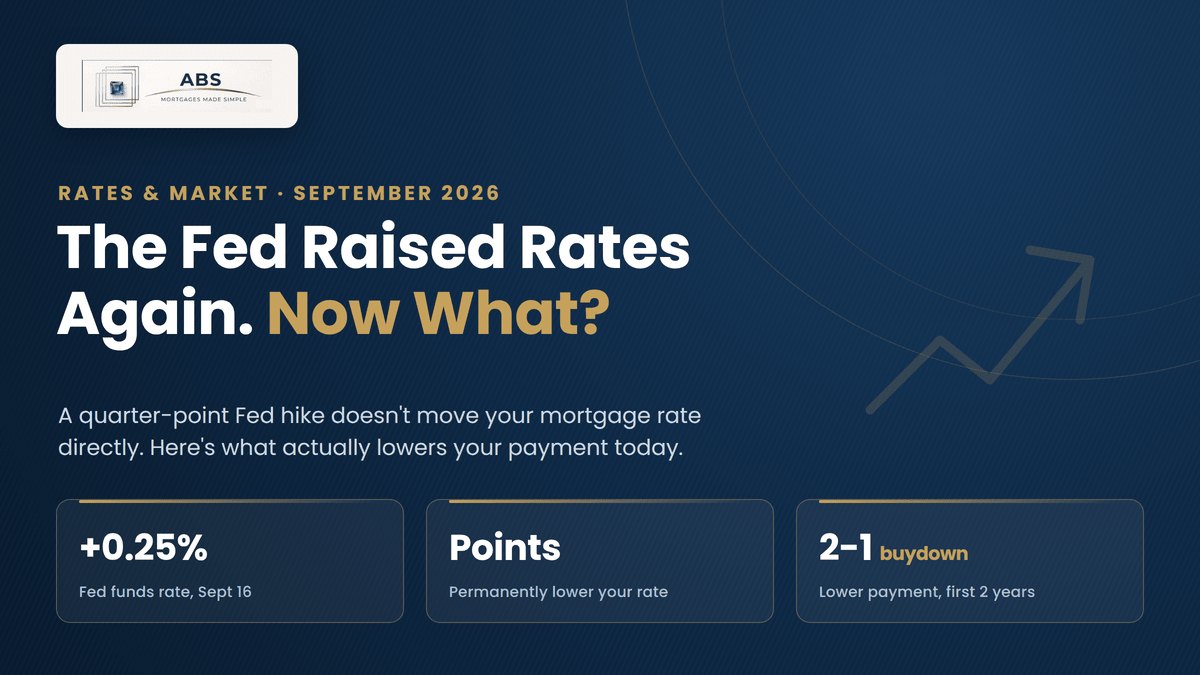
The Fed raised rates yesterday. Not cut — raised, for the first time since 2023. If you've been watching the housing market for the last few years, that probably sounds backwards, and it's worth thirty seconds understanding why before we get to what actually matters: what you do about your payment today.
What the Fed actually did on September 16
The FOMC voted 12-0 to raise the federal funds target range by a quarter point, to 3.75%-4.00%. That reverses course from where things stood after three rate cuts in late 2025, which had brought the range down to 3.50%-3.75%. The Committee held there through most of this year while it watched the data, and this week it moved the other direction.
The reason, in the Fed's own words: "Inflation remains elevated." That's true, but it's also not the whole picture. Headline CPI came in at 3.4% year-over-year in August, still well above the Fed's 2% target and pushed up mostly by a surge in gas prices. Core inflation — which strips out food and energy — actually fell to 2.4%, its lowest reading since March 2021. So the Fed is responding to the number that's moving in the wrong direction, even while the number that usually matters more to them is moving in the right one.
Two more meetings are on the calendar before year-end: October 28 and December 9. Whether either brings another hike depends on where inflation lands between now and then. I'm not going to predict that, and neither should you make a plan that depends on guessing it correctly.
Why this doesn't map directly onto your mortgage rate
Here's the part most coverage of a Fed decision skips: the federal funds rate is not your mortgage rate. It's the rate banks charge each other overnight, and it directly moves things like credit cards, HELOCs, and savings account yields. Mortgage rates track the 10-year Treasury and the mortgage-backed securities market instead, which move on where investors expect inflation and Fed policy to go over the next several years — not on the announcement itself.
In practice, that means mortgage rates often move before a Fed decision, as the market prices in what it expects, and then barely move on the day of the announcement if the Fed does what was expected. That's roughly what happened this week: the 30-year fixed was already climbing toward a one-year high in the days before Wednesday, averaging around 7.08% by the time the decision came down. As of this week, and subject to change daily with the market, that's meaningfully higher than the mid-6% range we were quoting as recently as this summer.
So the honest framing isn't "the Fed raised rates, so your rate went up." It's "the market has been pricing in a stickier inflation picture for weeks, the Fed's move confirmed it, and rates in the high-6s to low-7s look like they're here for a while rather than a blip."
The real question: what do you actually do about it
If you're buying in this environment, you have two real levers to bring your rate or payment down at closing, and they work in different ways. Understanding the difference matters more than any Fed headline.
Discount points: pay once, lower the rate for good
A discount point costs 1% of your loan amount, paid at closing, and permanently lowers your interest rate for the life of the loan. On a $400,000 loan, one point is $4,000.
The industry rule of thumb is that a point buys down your rate by roughly a quarter point, though the exact number moves with the lender, the loan program, and even the day you lock — nothing here is guaranteed, and we'll quote your actual pricing when we run your numbers. Here's what that looks like in practice: on a $400,000 loan, taking a hypothetical rate from 7.00% to 6.75% saves about $67 a month. At $4,000 for the point, that's roughly five years to break even. If you sell or refinance before then, you've paid for a discount you never fully collected.
That breakeven math is the entire decision. Points make sense when you're confident you'll hold the loan — and this rate — long enough to earn the discount back. They make less sense if there's a real chance you refinance in a couple of years, whether because rates ease or your situation changes. Run the actual numbers on our refinance break-even calculator before you decide, not after.
Points can be paid by you, or negotiated as a seller concession — worth raising in any offer where the seller has room to give.
Temporary buydowns: lower for a year or two, then it steps back up
A temporary buydown doesn't change your interest rate at all. Your note rate is fixed for the full 30 years from day one. What changes is your payment for a defined early period, funded by money placed in an escrow account at closing that subsidizes the difference between your real payment and a reduced one. When the subsidy period ends, your payment steps up to what the note rate always called for. There are three standard structures:
1-0 buydown — your effective rate is reduced by 1% in year one, then reverts to the full note rate in year two and beyond.
2-1 buydown — reduced by 2% in year one, 1% in year two, full rate from year three on.
3-2-1 buydown — reduced by 3% in year one, 2% in year two, 1% in year three, full rate from year four on.
Which of these three structures is available depends on your loan program. Conventional loans generally support all three — 1-0, 2-1, and 3-2-1. FHA loans, as structured today, support the 1-0 and 2-1 options only; the 3-2-1 isn't currently available on FHA financing. If you're using a different program, we'll confirm which structures your investor allows before you build a plan around one.
Here's what that looks like in dollars, using the same $400,000 loan and a hypothetical 7.00% note rate. A 2-1 buydown drops your payment from $2,661 to about $2,147 in year one (5.00% effective) and $2,398 in year two (6.00% effective), before stepping up to the full $2,661 in year three. Funding that costs a little over $9,300, held in escrow and drawn down automatically each month — you never have to do anything for it to work. A 3-2-1 buydown, which starts at a 4.00% effective rate, costs closer to $18,300 to fund over its three years. A 1-0 buydown, the smallest of the three, runs about $3,150.
Unlike points, this money can come from the seller, the buyer, or in some cases the lender — builders in particular have leaned on these heavily as a concession when they'd rather subsidize a payment than drop the price. If a seller is motivated and a price reduction isn't on the table, ask about a temporary buydown instead; it often costs the seller less than the equivalent price cut would.
The catch, and I want to be direct about it: your payment jump at the end of the subsidy period is not optional and does not depend on rates moving. If you can't comfortably afford the year-three payment on a 2-1 buydown, don't take one hoping to refinance your way out before it arrives — plan as if the higher payment is permanent, and treat an earlier refinance as a bonus if rates cooperate. If that's your plan, a no-cost refinance is worth understanding now, before you need it.
One more thing worth confirming case by case: how a temporary buydown affects the rate you have to qualify at varies by loan program and investor guidelines. Some programs let you qualify at the bought-down payment; most require you to qualify at the full note rate regardless. That's not a detail to guess on — it's one we check before you count on a lower payment getting you approved for more house.
Points and buydowns aren't the only two options, and they're not mutually exclusive
You can also simply take the market rate with no buydown and keep more cash for reserves or a larger down payment — often the right call if you don't have a clear use for the up-front money, or if compensating factors already put you in a strong position. And there's no rule against combining approaches, or comparing a seller-paid buydown against a straight price reduction to see which actually nets you more. That comparison is exactly what a phone call gets you, and it takes ten minutes, not a guess.
What this means if you're waiting for rates to drop
I get the instinct to wait, especially after a week like this one. But "wait and see" isn't a strategy against a Fed that itself doesn't know whether it hikes again in October — it's a bet, and it's one where the other side (home prices, and the buyers who show up the moment rates do fall) tends to move against you. We've written more on why that trade usually doesn't pay off in our piece on waiting for the "perfect" rate. Points and temporary buydowns exist precisely for this environment — tools that let you buy today at a payment you can live with, without betting your plans on what the Fed does next.
To compare discount points with 1-0, 2-1 and 3-2-1 temporary buydowns side by side, see our rate buydown options page.
Common questions
Did the Fed raise mortgage rates on September 16?
Not directly. The Fed raised the federal funds rate, which is a different rate that mortgage pricing doesn't track one-to-one. Mortgage rates had already been climbing for weeks on the expectation of this move, and the 30-year fixed was averaging around 7.08% the day of the decision.
What's the actual difference between a discount point and a temporary buydown?
A point permanently lowers your interest rate for the life of the loan and costs 1% of the loan amount. A temporary buydown doesn't change your rate at all — it funds an escrow account that subsidizes your payment for a set period (one, two, or three years), after which your payment steps up to the full note rate.
Can the seller pay for either one?
Yes to both. Seller-paid points and seller-funded temporary buydowns are both common concessions, subject to the contribution limits of your specific loan program. Temporary buydowns can also be funded by the buyer or, in some cases, the lender.
Will I qualify based on the bought-down payment or the real one?
It depends on your loan program and the investor guidelines behind it — this isn't a detail to assume either way. We confirm it as part of running your actual numbers rather than guessing from a rule of thumb.
What happens if rates haven't dropped by the time my temporary buydown ends?
Your payment steps up to the full note rate regardless of what rates have done elsewhere. Budget for that jump as your real payment from day one; treat an earlier refinance as a bonus, not the plan.
How much does one discount point actually save?
It depends on pricing that day, but a common rule of thumb is roughly a quarter-point rate reduction per point. On a $400,000 loan at a hypothetical 7.00% rate, one point ($4,000) taking the rate to 6.75% saves about $67 a month — a breakeven of roughly five years. Always run your specific numbers rather than relying on the rule of thumb.
Is the Fed likely to raise rates again this year?
The next two FOMC meetings are October 28 and December 9. Whether either brings another hike depends on inflation data between now and then, and I'm not going to guess it for you. What I'd say instead: build your plan around a rate you can afford today, not one you're hoping for in December.
Want the actual numbers for your situation — points, a temporary buydown, or neither? Call 630-357-1600, reach me directly at 630-301-8823, or email bsaggar@absmtg.com. I'll price it out against where rates actually sit today, not where we wish they were.
Figures are current as of September 17, 2026 and are subject to change without notice; mortgage rates move daily. Rate, payment, and buydown-cost examples in this article are hypothetical illustrations on a $400,000 loan at an assumed 7.00% note rate, used to show how the math works — they are not a quote and are not a commitment to lend. Actual pricing depends on your credit profile, loan program, property, and market conditions the day you lock. This article is general information, not financial, tax, or legal advice.
Follow us on Google: Add ABS Home Mortgage as a preferred source
Related Reading
Stop Waiting for the 'Perfect' Rate: A Smarter Way to Buy a Home in 2026
Waiting for mortgage rates to plunge has quietly become one of the most expensive mistakes a homebuyer can make. Here's what today's market actually looks like.
Read articleNo Closing Cost Refinance: Why It Matters Most If Rates Drop Again
We cover the closing costs associated with the loan — which means no break-even to wait for. If rates drop again, you may be able to refinance again.
Read articleFHA Loans in 2026: What 3.5% Down Actually Costs You
Credit score minimums, 2026 loan limits, how long mortgage insurance really lasts, gift funds, seller credits, and when conventional costs less.
Read articleFirst-Time Home Buyer Guide: Naperville 2026
What you can actually afford with DuPage County taxes, down payment minimums, neighborhood pricing by ZIP, Illinois assistance programs, and the pre-approval process.
Read articleInside a 21-Day Close: What Happens Each Week, and What Slows It Down
Our average purchase closing is 21 calendar days. Here's exactly what happens each week — documents, underwriting, appraisal, title, and the Closing Disclosure clock.
Read articleShould You Buy Mortgage Points? What Reddit Gets Right, and What It Misses
When discount points pay off, the break-even math, and what Reddit's 3-year rule leaves out.
Read articleMore in Rates & Market News · All mortgage guides