Reverse Mortgages in 2026: What a HECM Actually Costs You

Most people's idea of a reverse mortgage is "the loan that takes your house." That's not how it works, and it's not even the most useful way to think about it.
Here's the better frame: a reverse mortgage is a way to convert home equity you've already built into cash, without selling the home or taking on a monthly payment. You're still borrowing money and still paying for that borrowing — in mortgage insurance and accruing interest instead of a monthly bill. Whether that trade makes sense depends on your numbers, your plans for the home, and what else you have to draw on in retirement. Most of the articles on this topic sell the benefit and skip the mechanism.
What a reverse mortgage actually is
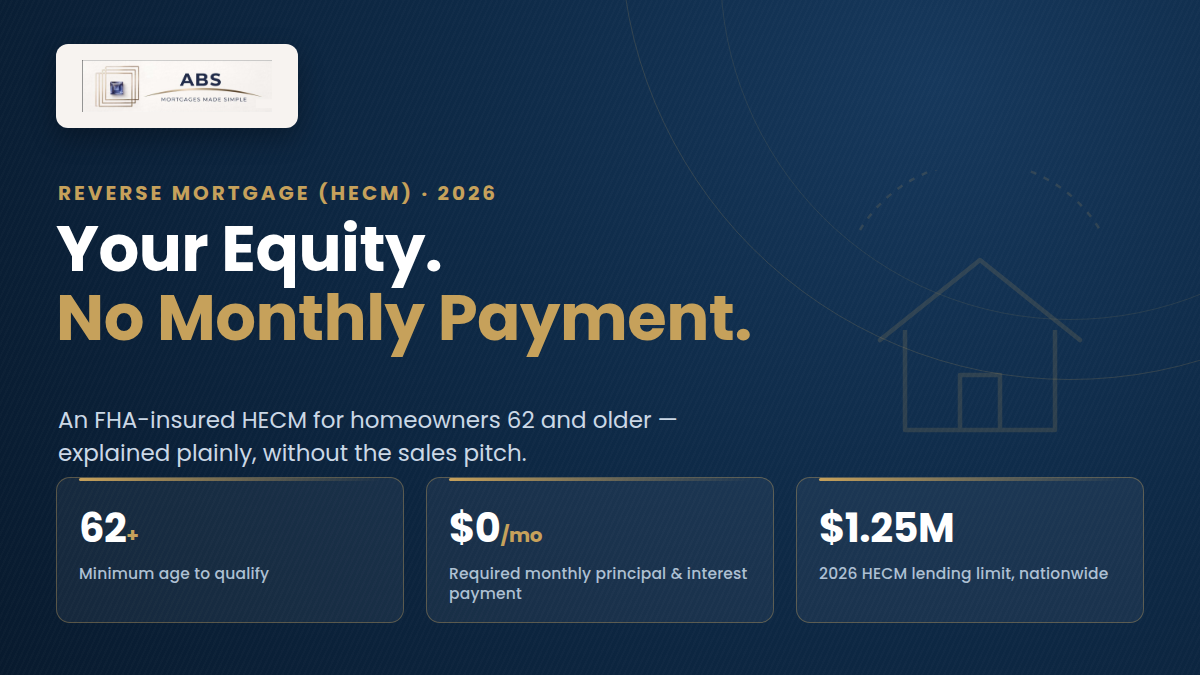
The product almost everyone means when they say "reverse mortgage" is a Home Equity Conversion Mortgage, or HECM — insured by the Federal Housing Administration, available to homeowners 62 and older. Unlike a regular mortgage, where you borrow a lump sum and pay it down every month, a HECM works the other direction: you (or your estate) owe more over time, not less, and there's no required monthly principal-and-interest payment as long as you live in the home, keep the taxes and insurance current, and maintain the property.
You still own the home. A HECM is a lien against it, the same as any mortgage — not a sale, and not a transfer of title. That distinction gets lost in how the product is marketed, and it's the first thing worth being clear about.
The age and equity requirements
You need to be at least 62, and the home needs to be your principal residence — occupied at least six months a year. Vacation homes, rental property, and investment property don't qualify.
You'll also need meaningful equity. There's no fixed percentage, because how much you can borrow depends on your age (or, if you're married, your spouse's age if they're a co-borrower), current interest rates, and the home's appraised value up to the 2026 lending limit. As a rough guide, most borrowers need somewhere in the range of 40–60% equity, though that range moves with rates and age — older borrowers with more equity get a larger share of the home's value in proceeds. If you still owe a meaningful amount on a traditional mortgage, HECM proceeds are typically used to pay that off first, at closing, which is often the whole reason someone looks at a HECM in the first place: replacing a mortgage payment with none at all.
What it actually costs
This is the part that decides whether a HECM is worth it, so I'll be specific.
There's an upfront mortgage insurance premium of 2% of your Maximum Claim Amount — the lesser of your home's appraised value or the 2026 national lending limit of $1,249,125. Then there's an annual premium of 0.5% of your outstanding loan balance, which accrues along with interest rather than being billed monthly.
The origination fee is capped by HUD at $6,000, calculated as 2% of the first $200,000 of your home's value plus 1% of any amount above that. On a $400,000 home, that's $4,000 + $2,000 = $6,000 — the cap, in this case, is the actual fee.
Two costs get paid upfront regardless of whether your loan closes: the appraisal (typically $550–$800) and the HUD-approved counseling session (typically $125–$200). Everything else — title insurance, recording fees, credit report, flood certification, settlement fees — is usually rolled into the loan balance rather than paid out of pocket.
None of this is a monthly bill. All of it reduces the equity you or your heirs will have left when the loan comes due.
How much you can actually get, and how you receive it
Your available proceeds — sometimes called your principal limit — come from a HUD formula based on the youngest borrower's age, current interest rates, and the home's value up to $1,249,125. You can take it as a lump sum, a line of credit that grows over time whether or not you draw on it, fixed monthly payments for a set term or for as long as you live in the home (tenure payments), or some combination.
The growing line of credit is worth understanding on its own: unlike a HELOC, where your available credit doesn't increase, an unused HECM line of credit grows at the same rate the loan accrues interest. For someone who doesn't need the money yet but wants it available later, that growth is a real, if often overlooked, feature.
What happens to the balance over time
Because there's no required monthly payment, the loan balance grows — interest and mortgage insurance accrue against it every month, the same way a savings account grows in reverse. That's the trade you're making: liquidity now, in exchange for less equity later.
The one protection worth knowing well is that a HECM is non-recourse. You or your heirs will never owe more than the home is worth when the loan comes due, no matter how large the balance has grown or how much the home's value has changed. If the balance ends up higher than the home's value, FHA's mortgage insurance fund — funded by the premiums above — covers the difference to the lender. That guarantee is what the mortgage insurance is actually paying for.
The counseling requirement isn't a formality
Before you can even apply for a HECM, HUD requires an independent counseling session with a HUD-approved counselor who has no financial stake in whether you take the loan. It covers the costs, the alternatives, and what happens to the loan over time — and it's designed specifically so you're not hearing all of this for the first time from someone who benefits if you sign.
Lenders also run a financial assessment that's different from a traditional debt-to-income review: instead of a credit score cutoff, HUD looks at your residual income (what's left after essential expenses) and your payment history on housing-related obligations — taxes, insurance, HOA dues — over the past 24 months. If that history shows some risk, the lender may set aside part of your proceeds in a Life Expectancy Set-Aside to cover future tax and insurance payments, rather than denying the loan outright.
What happens when the loan comes due
The loan becomes due and payable when the last surviving borrower (or eligible non-borrowing spouse) dies, sells the home, or no longer lives there as their principal residence — including an absence of more than 12 consecutive months in a healthcare facility with no co-borrower remaining in the home. It can also become due early if you fall behind on property taxes, homeowners insurance, or home maintenance, since those are conditions of keeping the loan current, not optional extras.
When the loan comes due, your heirs have real options: pay off the balance (often by selling the home) and keep any remaining equity, sell the home themselves and keep what's left after the loan is repaid, or simply let the lender take the property if the balance has grown larger than the home's value — non-recourse protection means they'll never owe the difference out of their own pocket.
If you're married and your spouse is younger than 62, they can be listed as an eligible non-borrowing spouse at closing, which lets them stay in the home for life after you pass, even though the loan technically stops accruing new payments to you.
Who a HECM is actually built for
It tends to make sense when you plan to stay in the home for years, not months; when a mortgage payment (or the lack of other liquid savings) is genuinely constraining your retirement income; and when you understand — and are comfortable with — leaving less equity to your estate in exchange for cash flow or a credit line today.
It tends to be the wrong tool when you're planning to move within a few years (the upfront costs don't have time to make sense), when a standard refinance or HELOC would cost less for a shorter-term need — see our guide on no-closing-cost refinancing if lower upfront costs matter more to you than tapping equity, or when leaving the home to heirs debt-free matters more to you than the liquidity a HECM provides. There's no universally right answer here — it's a genuine trade-off, not a product everyone in retirement should have.
How to actually get started
Because HUD requires independent counseling before an application, the honest first step isn't a call to us — it's that counseling session, so you're evaluating the numbers with someone who has nothing to sell you. After that, we can walk through your specific figures: your age, your home's value, what you currently owe, and what you're actually trying to solve for. See our reverse mortgage program page for the full breakdown of costs, requirements, and FAQs in one place.
Common questions
What is a HECM reverse mortgage?
A Home Equity Conversion Mortgage — an FHA-insured loan for homeowners 62 and older that converts home equity into cash, as a lump sum, a line of credit, monthly payments, or a combination, with no required monthly mortgage payment as long as you live in the home and keep taxes, insurance, and maintenance current.
Do I still own my home with a reverse mortgage?
Yes. A HECM is a lien against the property, the same as a traditional mortgage — not a sale or a transfer of title. You keep ownership, and any equity remaining when the loan is repaid belongs to you or your estate.
What are the ongoing costs of a HECM?
An annual mortgage insurance premium of 0.5% of your outstanding balance, plus accruing interest — both add to the loan balance rather than being billed monthly. You're still responsible for property taxes, homeowners insurance, and upkeep, the same as with any mortgage.
What does the required counseling session involve?
An independent, HUD-approved counselor — with no financial stake in your decision — walks through the costs, the alternatives, and what happens to the loan over time, before you're allowed to apply. It typically costs $125 to $200 and is paid upfront regardless of whether you go on to close a loan.
How much money can I actually get?
It depends on the youngest borrower's age, current interest rates, and your home's appraised value up to the 2026 national lending limit of $1,249,125. Older borrowers with more home equity generally receive a larger share of that value in proceeds.
What are the upfront costs?
An upfront mortgage insurance premium of 2% of your Maximum Claim Amount, an origination fee capped at $6,000 (2% of the first $200,000 of home value plus 1% of the remainder), and an appraisal and counseling fee that are typically paid out of pocket regardless of whether the loan closes. Most other closing costs are financed into the loan.
What happens to the loan when I sell, move, or pass away?
It becomes due and payable when the last surviving borrower dies, sells the home, or no longer lives there as a principal residence — including more than 12 consecutive months in a healthcare facility with no co-borrower remaining in the home. Heirs can pay it off and keep the home, sell it and keep any remaining equity, or walk away without owing the difference if the balance exceeds the home's value.
Can my spouse stay in the home if I pass away first?
Yes, if they're listed as an eligible non-borrowing spouse at closing — they can remain in the home for life, even if they were younger than 62 and not a borrower on the loan themselves.
What happens if the loan balance grows larger than my home is worth?
Nothing you have to cover personally. A HECM is non-recourse: you and your heirs will never owe more than the home's value when the loan comes due, regardless of how large the balance has grown. FHA's mortgage insurance covers the difference to the lender.
Do you offer proprietary or jumbo reverse mortgages?
Not currently — our reverse mortgage program is the FHA-insured HECM described here. If your home's value is well above the $1,249,125 lending limit, a proprietary reverse product not backed by FHA might fit better; ask us and we'll point you toward the right resource rather than force a HECM that doesn't make sense for your numbers.
Wondering whether the numbers actually work for your situation? Call 630-357-1600, reach me directly at 630-301-8823, or email bsaggar@absmtg.com. I'll walk through your age, your home's value, and what you're trying to solve for — the honest math, not a pitch.
Figures are current as of September 2026 and are subject to change. The 2026 HECM lending limit, mortgage insurance premiums, and origination fee cap are set by HUD; individual lenders and investors may apply additional requirements. This article is general information, not financial, tax, or legal advice — HUD-approved counseling is required before applying for a HECM, and we encourage anyone considering one to complete that counseling and consult a financial advisor and their family before deciding.
Follow us on Google: Add ABS Home Mortgage as a preferred source
Related Reading
No Closing Cost Refinance: Why It Matters Most If Rates Drop Again
We cover the closing costs associated with the loan — which means no break-even to wait for. If rates drop again, you may be able to refinance again.
Read articleFirst-Time Home Buyer Guide: Naperville 2026
What you can actually afford with DuPage County taxes, down payment minimums, neighborhood pricing by ZIP, Illinois assistance programs, and the pre-approval process.
Read articleMore in Senior & Retirement · All mortgage guides