FHA vs. Conventional in Illinois 2026: The Difference Is How Long You Pay for It

Most articles on this answer the question backwards. They list the features of each loan and leave you to guess which one fits.
Here is the version I give clients. There is one difference between FHA and conventional that matters more than all the others combined, and once you understand it the rest of the decision usually makes itself.
The difference that actually decides it
Both loans charge you for mortgage insurance when you put down less than 20%. The difference is how long you pay it.
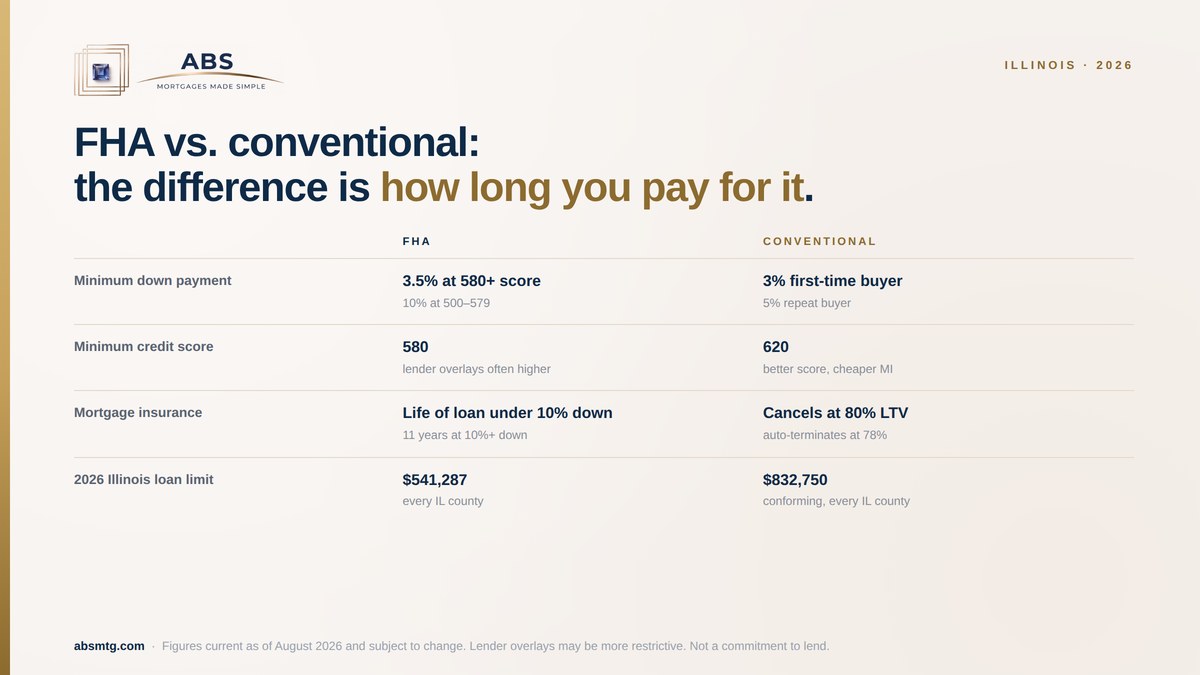
On a conventional loan, private mortgage insurance comes off. You can request cancellation once your balance is scheduled to reach 80% of the original value, and your servicer must terminate it automatically at 78% — provided you are current on payments. It is a temporary cost with a built-in end date.
On an FHA loan, it depends on your down payment, and the threshold is 90% loan-to-value:
- Put down 10% or more, and annual mortgage insurance premium drops off after 11 years.
- Put down less than 10%, and MIP stays for the life of the loan.
A standard FHA purchase with 3.5% down is 96.5% LTV. That is well above the threshold, so the MIP never comes off. On a 30-year loan, you pay it for 30 years.
That is the whole ballgame. Everything else is a detail by comparison.
What each one costs
FHA charges an upfront mortgage insurance premium of 1.75% of the base loan amount, which is typically financed into the loan rather than paid in cash. Then an annual premium of 0.55% at the 3.5%-down tier, or 0.50% if you put down 10% or more and take the 11-year clock. On a $350,000 loan, that annual premium runs roughly $160 a month, and at 3.5% down it does not stop.
Conventional PMI has no upfront fee. The monthly cost varies with your credit score and down payment — better credit buys meaningfully cheaper coverage, which is not how FHA works. FHA MIP is the same rate whether your score is 580 or 780.
That last point is worth sitting with. If your credit is strong, conventional almost always costs less. FHA does not reward you for a good score. Conventional does.
Where FHA is still the better loan
I am not talking anyone out of FHA. It exists for good reasons and it is the right answer often.
Credit below 620. HUD allows FHA at a 580 score with 3.5% down, and between 500 and 579 with 10% down. Conventional generally starts at 620. If you are at 590, this is not a close call — FHA is your path. Note that HUD's 580 is a floor, not a promise; most lenders apply their own overlay, commonly in the 600 to 640 range.
Debt-to-income that runs high. FHA is generally more forgiving on DTI than conventional, which matters a great deal in Illinois for a reason I will get to.
Recent credit events. Bankruptcy, foreclosure, collections — FHA's seasoning requirements are typically shorter and its underwriting more tolerant of a rough patch that has since been fixed.
Manual underwriting. When a file does not fit an automated box, FHA has a documented path for a human to make the call. Conventional has less room.
Where conventional wins
The insurance ends. Covered above, and it is the biggest one.
Three percent down is real. You do not need 5% and you certainly do not need 20%. Standard conventional allows 3% down on a one-unit primary residence — but at least one borrower has to be a first-time buyer, and the loan has to be a fixed-rate mortgage. Repeat buyers on standard conventional are held to 5% down.
Income-based programs go further. Fannie Mae's HomeReady and Freddie Mac's Home Possible both allow 3% down with reduced mortgage insurance coverage, for borrowers at or below 80% of area median income. For a lot of Illinois buyers these price better than FHA, and almost nobody asks about them.
Your credit score works for you. Better score, cheaper insurance, better rate.
The Illinois numbers for 2026
This is where the local part matters, and where a lot of national articles will steer you wrong.
The conforming loan limit is $832,750 for a one-unit property. The FHA limit is $541,287. Both figures apply to every one of Illinois' 102 counties — Cook, DuPage, Will, Lake, Kane, McHenry and every downstate county alike. Illinois has no high-cost designation, so there is no county where FHA reaches higher.
The practical consequence: above $541,287, FHA is simply not available in Illinois. Not harder, not more expensive — unavailable. In parts of DuPage and the North Shore that threshold gets crossed routinely, and once you are past it the decision is between conventional and jumbo, not between FHA and conventional.
There is a smaller wrinkle worth knowing. FHA's higher annual MIP tier only applies to base loan amounts above $726,200, and no Illinois FHA loan can reach that. So Illinois FHA borrowers are always in the lower premium tier.
If you are here on a visa, this decision was made for you
This is the change most people have not caught up to.
HUD's Mortgagee Letter 2025-09 removed non-permanent residents from FHA eligibility entirely, for case numbers assigned on or after May 25, 2025. If you are on an H-1B, L-1, or another temporary work visa, FHA is closed to you. Lawful permanent residents are still eligible on the same terms as citizens.
Conventional financing did not change. Fannie Mae continues to purchase loans made to non-permanent residents on the same terms available to U.S. citizens.
So for a visa-holder buyer in Naperville or Schaumburg, conventional is not the better option — it is the only agency option. We wrote about this in more detail in our H-1B and NRI mortgage guide, and for households where one spouse works on an H-4 EAD, that income question has its own answer.
Illinois property taxes change the math
Illinois has the second-highest effective property tax rate in the country — roughly 1.88% of owner-occupied home value on average, based on 2024 data.
Your property tax bill is part of your monthly payment and counts in your debt-to-income ratio, which means it directly limits how much home you qualify for. In Illinois it is often the single largest variable in that calculation, and it is why an out-of-state lender's pre-approval can be optimistic by a wide margin.
County averages hide more than they reveal. Within Cook County alone, effective rates have ranged from under 1.7% in Chicago to well over 4% in some south suburbs. Oak Brook sits near 1.09%; some collar-county municipalities are above 2.6%. Two houses at the same price in different towns can carry a difference of several hundred dollars a month, and that difference decides whether your file qualifies.
This cuts both ways in the FHA-versus-conventional decision. High taxes push DTI up, which argues for FHA's flexibility. But FHA's MIP also adds to the monthly payment, which pushes DTI back up. Which effect wins depends on your numbers, not on a rule of thumb.
Down payment assistance works with both
Illinois has real down payment assistance through IHDA, and it is not FHA-only. IHDA's programs pair with FHA 203(b), VA, USDA, and the conventional HFA Preferred and HFA Advantage products.
As of 2026 the programs include IHDAccess Home, launched in March 2026, offering 6% of the purchase price up to $15,000 as a 0% interest deferred second mortgage with no monthly payment, for first-time buyers. IHDAccess Repayable offers up to $10,000 repaid over ten years. IHDAccess Deferred offers up to $7,500 deferred for 30 years. IHDAccess Forgivable offers up to $6,000, forgiven over ten years.
They generally require a 640 credit score, cap back-end DTI at 50%, require a minimum borrower contribution of the greater of 1% of the purchase price or $1,000, and require pre-purchase homebuyer education. Income and purchase price limits are set by county and change periodically — we check the current figures for your county when we run your file.
Note the 640 score requirement. If your score is the reason you were leaning FHA, it may also be the reason assistance is not available yet, which changes the sequencing of your whole plan.
How to actually decide
Run it in this order.
Is the loan amount above $541,287? If yes, FHA is out in Illinois. Stop here.
Are you a non-permanent resident? If yes, FHA is out. Stop here.
Is your credit score below 620? If yes, FHA is likely your path — and it is a perfectly good one.
Is your score comfortably above 680? Conventional will almost certainly cost less, both in monthly insurance and in the fact that the insurance ends.
Are you between 620 and 680? This is the genuinely close range, and it deserves an actual side-by-side on your numbers rather than a rule. Ask for both.
And one thing people forget: choosing FHA today does not lock you in forever. If you take FHA because of credit and your score improves, refinancing to conventional later is how you get rid of the life-of-loan MIP. That is one of the better reasons to keep your costs low on the way in — a no closing cost refinance leaves nothing to earn back if you end up making that move sooner than you expected.
Common questions
Is FHA or conventional better in Illinois?
Neither is better in the abstract. FHA is generally better below a 620 credit score, with recent credit events, or with high debt-to-income. Conventional is generally better above roughly 680, because private mortgage insurance is priced by credit score and cancels at 78 to 80% loan-to-value, while FHA mortgage insurance at 3.5% down lasts for the life of the loan.
What is the FHA loan limit in Illinois for 2026?
$541,287 for a one-unit property, and it is the same in every Illinois county including Cook, DuPage, Will, Lake, Kane and McHenry. Illinois has no FHA high-cost counties. The 2026 conforming loan limit for conventional financing is $832,750, so above $541,287 conventional or jumbo financing is the path.
Does FHA mortgage insurance ever go away?
Only if you put at least 10% down, in which case the annual premium ends after 11 years. Below 10% down — including the standard 3.5% down purchase — annual MIP lasts for the full loan term. Refinancing into a conventional loan is the usual way borrowers eliminate it.
Can H-1B visa holders get an FHA loan in 2026?
No. HUD Mortgagee Letter 2025-09 removed FHA eligibility for non-permanent residents for case numbers assigned on or after May 25, 2025. Lawful permanent residents remain eligible. Conventional financing is still available to non-permanent residents on the same terms available to U.S. citizens.
How much down payment do I need in Illinois?
FHA requires 3.5% down with a 580 or higher credit score, or 10% down between 500 and 579. Conventional allows 3% down for first-time buyers on a fixed-rate loan and 5% for repeat buyers, with HomeReady and Home Possible also allowing 3% down for borrowers at or below 80% of area median income. IHDA down payment assistance can be layered on top of either.
Not sure which side of the line you fall on? Call 630-357-1600, reach me directly at 630-301-8823, or email bsaggar@absmtg.com. Ask for both scenarios priced on your actual numbers — with your county's tax rate, your score, and your loan amount. That comparison takes one conversation and it is the only way to answer this honestly.
Figures are current as of August 2026 and are subject to change. 2026 loan limits are set by FHFA and HUD and are adjusted annually. Mortgage insurance premiums, credit score requirements and program terms are set by HUD, Fannie Mae, Freddie Mac and individual investors, and lender overlays may be more restrictive than agency minimums. IHDA program terms, income limits and purchase price limits are set by the Illinois Housing Development Authority, vary by county and are subject to change — confirm current figures before relying on them. Property tax rates vary widely by municipality and taxing district. This article is general information, not financial, tax or legal advice.
Follow us on Google: Add ABS Home Mortgage as a preferred source
Related Reading
FHA Loans in 2026: What 3.5% Down Actually Costs You
Credit score minimums, 2026 loan limits, how long mortgage insurance really lasts, gift funds, seller credits, and when conventional costs less.
Read articleH-1B & NRI Mortgage Guide 2026
Visa-holder and non-resident borrower playbook: down payment, docs, and how to qualify with foreign income.
Read articleFirst-Time Home Buyer Guide: Naperville 2026
What you can actually afford with DuPage County taxes, down payment minimums, neighborhood pricing by ZIP, Illinois assistance programs, and the pre-approval process.
Read articleMore in First-Time Buyer · All mortgage guides