Atlanta Metro Investor Guide: DSCR, Taxes and the Counties Worth Watching

An investor called me last month about a rental under contract in Clayton County. Good rent-to-price ratio, DSCR penciled fine on paper. What hadn't been priced in was the tax bill — because the property tax rate on that side of the metro runs nearly double what it does forty minutes north in Cherokee County, and nobody on the deal had flagged it before the numbers got run.
That's the pattern I want to walk through here. Metro Atlanta isn't one market. It's a dozen-plus counties with different tax rates, different growth trajectories, and — if short-term rental income is part of the plan — completely different rules about whether that's even legal. If you're financing with a DSCR loan, all three of those things show up directly in your ratio, not as background noise.
What DSCR actually measures, quickly
DSCR is Monthly Rental Income ÷ Monthly PITIA — principal, interest, taxes, insurance, and association dues. Above 1.0, the rent covers the payment. Below 1.0, you're bringing cash to close the monthly gap, and most DSCR lenders either won't do the loan or will price it noticeably worse.
Two of the four letters in PITIA — taxes and insurance — vary more by county in Georgia than most investors expect, which is the whole reason "Atlanta is a good rental market" isn't a useful sentence without a map attached. If you haven't seen how the ratio gets built loan to loan, our DSCR loan guide walks through the mechanics, and the DSCR down payment breakdown covers how leverage moves it in more detail than I'll repeat here. Run your own numbers on the DSCR calculator before you call — it takes less time than reading the rest of this article.
Property taxes: the number that moves by county, not by city
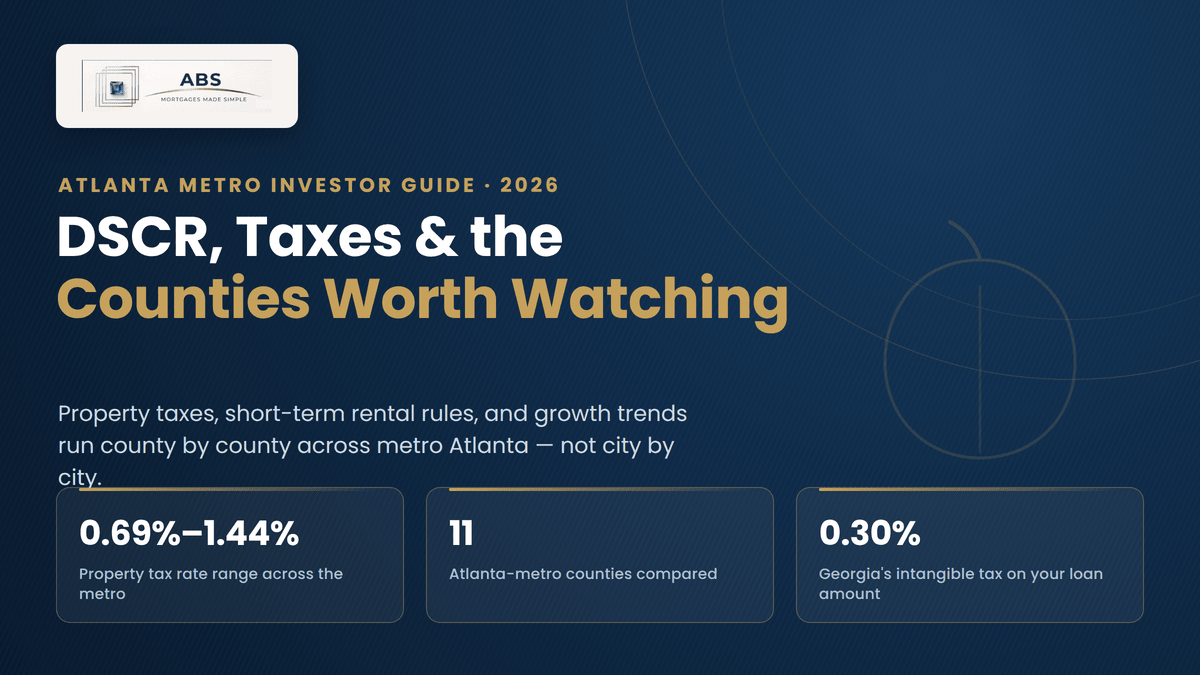
Here's where an out-of-state DSCR buyer usually gets surprised. Effective property tax rates across the core Atlanta-metro counties span roughly double, low to high:
| County | Effective property tax rate* | Where it lands |
|---|---|---|
| Cherokee | 0.69% | Lowest of the group |
| Fulton | 0.75% | Below average |
| Forsyth | 0.85% | Below average |
| Fayette | 0.89% | Near average |
| Gwinnett | ~0.97% | Near average |
| Cobb | 0.98% | Near average |
| Rockdale | 1.00% | Above average |
| Paulding | 1.03% | Above average |
| DeKalb | 1.22% | High |
| Douglas | 1.27% | High |
| Clayton | 1.44% | Highest of the group |
*Effective rate = typical annual tax bill ÷ market value, from county-level data compiled by Ownwell (April 2026) and TaxByCounty (Gwinnett, March 2026). Georgia's statewide average sits around 0.81%, so several of these counties run meaningfully above or below the state figure, not just the metro figure.
Here's the part that catches investors specifically, and it's worth being precise about. Georgia's homestead exemptions — including the "floating" homestead exemption that caps how fast assessed value can rise — apply only to an owner's primary, owner-occupied residence. A rental property doesn't qualify, full stop. That means a homeowner next door to your rental can have their taxable value capped year over year while your assessment resets to full market value at reassessment, with no ceiling. A new state law (the HOME Act, effective January 1, 2027) will make that floating cap mandatory statewide for homesteaded properties and widen the gap further — investment property gets none of the benefit either way.
Practically: don't underwrite a DSCR deal using the seller's current tax bill if the seller lived there. Pull the non-homestead millage rate for that specific county and city, or ask us to do it before you lock your numbers — it's a five-minute check that changes the ratio more than people expect.
Counties worth watching, and why "growth" doesn't mean the same thing everywhere
The Atlanta Regional Commission's latest count has the 11-county metro adding about 64,400 residents in the year to April 2025, with Forsyth and Cherokee posting the fastest growth rates in the region, followed by the City of Atlanta and Henry County. A separate look at cumulative growth over the prior several years shows the same story from a different angle: the outer counties — Forsyth, Cherokee, Paulding, Henry — are growing two to three times faster than the core counties of Fulton, Cobb, and DeKalb.
The employer story backing that up is increasingly a data-center story. Coweta County approved a roughly 900-megawatt, multibuilding data center campus in April 2026 after a contested local vote, and it's one of several such projects proposed in that corridor. Fayette County's film and TV production base, anchored by Trilith Studios, remains a steady local employer even without a single new headline number attached to it this year.
Rent growth is the one place I'd push back on the easy version of this story. Metro-wide multifamily rents are forecast to climb in 2026 as new supply slows to its lowest pace in over a decade, but the single-family rental segment specifically — the property type most DSCR buyers actually finance — ran roughly flat to slightly down year over year as of early 2026, even as build-to-rent construction (over 6,800 units underway in the metro) signals real underlying demand. Both things are true at once: strong leasing velocity and a healthy pipeline, alongside SFR rents that haven't caught up to the multifamily story yet. Model your rent assumption from actual comparable leases in that county, not a metro headline.
Short-term rental: don't underwrite a deal around it without checking the zip code
If part of your plan is short-term rental income, check the actual jurisdiction before you assume it's allowed — Atlanta metro is not one set of rules.
The City of Atlanta's short-term rental ordinance caps a host at their primary residence plus one additional unit. There's no path for an owner without an Atlanta primary residence to get licensed at all, which means city-of-Atlanta STR is effectively unavailable to most out-of-state DSCR investors as a strategy, not just a paperwork hurdle. Sandy Springs goes further: short-term rental is permitted only for owner-occupied properties verified through the homestead exemption, so non-owner-occupied STR isn't a legal use category there at all. A 2025 enforcement case in Sandy Springs against an out-of-state operator ended in a court restraining order and city legal fees owed by the owner — a real example, not a hypothetical.
Other cities and unincorporated county areas across the metro each set their own STR rules, and none of them mirror Atlanta's or each other's exactly. If STR income is load-bearing in your DSCR math, verify the specific city or unincorporated-county code for that property before you count on it, and have a long-term-rental fallback number ready regardless.
What Georgia law actually says about landlords and tenants
Georgia law prevents any city or county from enacting rent control — that's true statewide, including inside the city of Atlanta, and it hasn't changed. Eviction for nonpayment tends to move faster in Georgia than in many states: no pre-filing notice is required, a tenant has a matter of days to respond once served, and uncontested cases are often resolved within a few weeks to a couple of months depending on the county court's docket. Security deposits have no statutory cap in dollar amount, but the landlord is required to hold the deposit in escrow or bond it with the court, provide a written move-in condition report, and return it within 30 days of move-out — miss that and Georgia law allows the tenant to recover triple the deposit plus attorney fees.
None of that is legal advice, and Georgia's specifics are worth a real conversation with a local attorney or property manager before you close, not a blog post.
The closing cost most out-of-state investors miss
Georgia charges an intangible recording tax on the note when your mortgage is recorded: $1.50 per $500 of loan amount, or 0.30% of what you're borrowing, capped at $25,000 per note. On a $400,000 DSCR loan, that's $1,200 due at closing — a real, state-specific line item that doesn't show up on a Texas or Florida closing disclosure and that investors comparing markets sometimes forget to budget for.
Insurance: milder than Florida, but don't call it cheap
Metro Atlanta doesn't carry Florida's hurricane exposure, but it isn't insulated either. Georgia homeowners insurance premiums rose roughly 24% from 2023 to 2025, with further increases expected through 2026, driven in real part by Hurricane Helene's inland damage in 2024 and a broader trend of storm intensity reaching further from the coast than it used to. Tornado and severe hail risk are also a recognized cost factor for Atlanta-area property specifically. Get an actual insurance quote before you finalize your DSCR numbers rather than estimating from a neighboring state's premiums — it's part of your PITIA, and it's the input most likely to move your ratio the wrong direction if you guess.
Who this actually works for
DSCR financing in metro Atlanta makes the most sense for buyers who can show the county-specific numbers pencil on their own — the real non-homestead tax bill, an actual insurance quote, and a rent estimate from comparable long-term leases rather than a short-term-rental assumption that may not be legal at that address. If your income doesn't fit a conventional file for other reasons — heavy write-offs, bank-statement income, recent self-employment — our broader non-QM loan programs cover more of those situations, and if you're weighing the tax side of holding rental property generally, what 100% bonus depreciation means for a rental portfolio is worth reading alongside this one. For financing a primary residence in the metro rather than a rental, our Atlanta mortgage page and the Georgia FHA vs. conventional breakdown cover that side separately.
Common questions
Is DSCR the only way to finance a rental in metro Atlanta?
No. Conventional investment-property financing is available if your personal income and debt-to-income ratio qualify on their own. DSCR exists for the more common case where the property cash-flows but your tax returns, due to legitimate write-offs or self-employment income, don't show enough qualifying income for a conventional file.
Which Atlanta-metro county has the lowest property taxes for an investor?
Of the counties compared here, Cherokee runs lowest at roughly 0.69% effective, with Fulton and Forsyth close behind in the 0.75%–0.85% range. Clayton, at roughly 1.44%, runs highest. These are area averages — always pull the specific parcel's current, non-homestead bill before you underwrite a deal.
Can I run a short-term rental in Atlanta if I don't live there?
Generally no. The city's ordinance limits STR licensing to a primary residence plus one additional unit, which leaves no path for an investor without an Atlanta primary residence. Some suburbs, like Sandy Springs, restrict STR to owner-occupied property entirely. Model these deals as long-term rentals unless you've confirmed the specific city or county allows non-owner-occupied STR.
Does my rental's property tax bill get capped the way a homeowner's does?
No. Georgia's homestead exemptions and assessment caps apply only to an owner-occupied primary residence. Investment property is reassessed to full market value with no cap, which is why a rental's tax bill can rise faster than a homesteaded neighbor's after a county reassessment.
What's the Georgia intangible tax, and when do I pay it?
It's a one-time tax on your loan amount, charged when the mortgage is recorded at closing: $1.50 per $500 borrowed, or 0.30% of the loan. It's separate from property tax and shows up as a closing cost, not an ongoing expense.
Is the Atlanta rental market actually growing right now?
Population and job growth are real, especially in outer counties like Forsyth, Cherokee, and Henry. Rent growth is more mixed — multifamily rents are forecast to rise in 2026 as new supply slows, but single-family rental rents specifically have run closer to flat. Use comparable local leases for your rent assumption rather than a metro-wide headline.
Does my out-of-state landlord experience transfer to Georgia?
Some of it will, but not all of it. Georgia has no rent control anywhere in the state, a comparatively fast eviction process for nonpayment, and specific rules on how security deposits must be held and returned. If your other rentals are in a state with different landlord-tenant law, don't assume the timelines or requirements carry over.
How do I figure out which county actually fits my strategy?
Start with what the deal needs to do: lowest carrying cost favors lower-tax counties like Cherokee or Fulton, growth exposure favors Forsyth, Cherokee, Henry, or the Coweta data-center corridor, and if short-term rental income matters, the city or unincorporated-county STR rule matters more than the county tax rate. Bring us the specific property and we'll run the real numbers rather than a county-wide estimate.
Want the real numbers for a specific county, not a metro-wide average? Call 630-357-1600, reach me directly at 630-301-8823, or email bsaggar@absmtg.com. I'll run your DSCR math against the actual non-homestead tax bill and an actual insurance quote for the property you're looking at.
Figures in this article are current as of September 2026 and are subject to change without notice. Property tax rates are county-level averages/medians compiled from third-party sources and will differ from any specific parcel's actual bill — always verify the current, non-homestead rate for your property before closing. Short-term rental ordinances and insurance pricing are set locally and change; confirm current rules for the specific city or county before relying on either in your underwriting. This article is general information, not tax, legal, or financial advice.
Follow us on Google: Add ABS Home Mortgage as a preferred source
Related Reading
DSCR Loans in Florida: The 2026 Investor Guide
The improved 2026 insurance environment, top markets like Tampa and Orlando, STR income rules, and what actually moves your DSCR ratio.
Read articleDSCR Loan Down Payments: How Much Do You Really Need in 2026?
How the down payment tiers actually work by DSCR ratio, credit score, and property type - and how to get to the lower end.
Read articleNo Income? No Problem: DSCR Loans in 2026
How investors qualify for rental-property financing on rental income alone - no W-2, no tax returns.
Read articleBonus Depreciation Is Back to 100% (OBBBA 2026)
How permanent 100% bonus depreciation pairs with DSCR financing to shelter income while keeping your portfolio scaling.
Read articleMore in DSCR & Investor · All mortgage guides