Can You Get a Reverse Mortgage at 55? Yes, but It Isn't a HECM

Most people think you have to be 62 to get a reverse mortgage. That's true for the one most people have heard of, the FHA-insured HECM. It isn't true for every reverse mortgage.
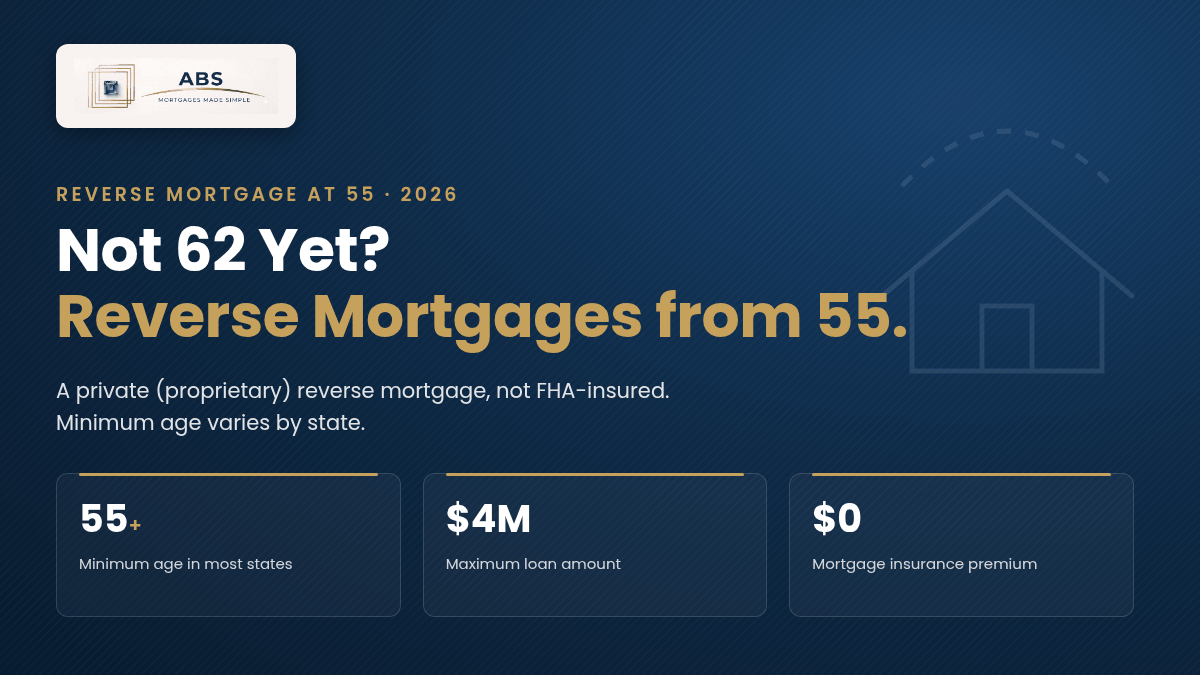
Here's the better frame: there are two kinds of reverse mortgage. The government-insured kind starts at 62. A private kind, called a proprietary reverse mortgage, can start at 55 in most states. Same basic idea, different rules, and the differences matter more than the age.
What a reverse mortgage does, in one paragraph
A reverse mortgage lets you borrow against your home's equity without a required monthly mortgage payment. You keep the title. Interest adds to the balance over time instead of being paid monthly. The loan is repaid when you sell, move out permanently, or the last borrower passes away. You still pay property taxes, homeowners insurance and upkeep. Miss those and the loan can come due.
If you want the full cost breakdown of the government version, I wrote that up in Reverse Mortgages in 2026: What a HECM Actually Costs You. This post is about the other one.
The 55+ option: what it is and who makes it
A proprietary reverse mortgage is made and backed by a private lender, not insured by FHA or backed by HUD. That one fact explains most of the differences:
- Age. 55 in most states. Some states set a higher minimum, so the first thing we check is your state.
- Loan size. Up to $4 million, versus the 2026 HECM limit of $1,249,125. That's why this product is often called a jumbo reverse mortgage.
- Mortgage insurance. None. A HECM charges 2% upfront and 0.5% a year. The proprietary loan doesn't, though it has its own origination and closing costs.
- How you get the money. A fixed-rate lump sum at closing, or an adjustable-rate line of credit where part of the money is drawn at closing.
- Non-recourse. You or your heirs never owe more than the loan balance or the home's value, whichever is less. With a HECM that protection comes from FHA insurance; here it comes from the loan terms.
Who it actually fits
The 55+ option makes sense in a few specific situations:
- You're between 55 and 61 and need the equity now. Paying off an existing mortgage to free up monthly cash is the most common reason.
- Your home is worth well above $1.25 million. A HECM caps the value it counts at the national limit. The proprietary loan can use more of a higher-value home.
- You want to keep your current first mortgage. A second-lien version lets eligible homeowners add a reverse mortgage behind an existing fully amortizing first mortgage, up to $1 million. It's refinance only.
- You're buying a home to retire in. The proprietary loan can be used on a purchase of a primary residence, like HECM for Purchase.
- Your condo isn't FHA-approved. Some non-FHA condos can still qualify through a single-unit review.
The trade-off nobody mentions: your spouse
This is the part I'd walk any couple through before anything else.
A HECM has protections for an eligible spouse who isn't on the loan. If the borrowing spouse dies, that spouse may be able to stay in the home without the loan coming due.
The proprietary loan does not have that protection. If your spouse is old enough to qualify and lives in the home, they generally need to be on the loan as a borrower. If your spouse is younger than the minimum age, talk it through with us before you go further. That one detail can decide which product is right.
Starting at 55 vs. waiting until 62
The younger the youngest borrower, the less you can typically borrow, because the loan has more years to grow. So starting at 55 usually means smaller proceeds than the same home would support at 62, and more years of interest building on the balance.
Waiting isn't automatically better either. If paying off a mortgage at 57 frees up real monthly cash for five years, that has value too. The honest answer depends on your age, your home's value, your existing loan and how long you plan to stay.
What I'd suggest: compare both side by side. Where both are available in your state, we lay the HECM options next to the proprietary one before you choose, and that comparison is the most useful number you'll see.
What qualifying looks like
- The home must be your primary residence. Single-family homes, townhomes, PUDs, 2–4 unit properties and some condos qualify.
- Independent reverse mortgage counseling is required before closing.
- A financial assessment reviews your credit, residual income and history of paying property taxes and insurance. Borrowers with strong credit may qualify for lighter income documentation. Some borrowers need a set-aside for future taxes and insurance.
- Everyone on the loan must live in the home. Non-occupant co-borrowers aren't allowed.
You can see both programs compared on our reverse mortgage page.
Common questions
Is a reverse mortgage at 55 the same thing as a HECM?
No. A HECM is insured by FHA and starts at 62. A reverse mortgage at 55 is a proprietary loan from a private lender. It isn't FHA-insured or HUD-backed, carries no mortgage insurance premium and can go up to $4 million.
Do I need counseling if I'm under 62?
Yes. Independent reverse mortgage counseling is required before closing on the 55+ loan too, so you hear the trade-offs from someone with no stake in the loan.
My spouse is 52. Can I still do this?
Possibly, but slow down first. The 55+ loan doesn't give a non-borrowing spouse the protection a HECM does, so if you pass away first, the loan can come due while your spouse still lives there. We'd walk through that scenario with both of you before anything else.
Can I keep my current mortgage?
If it's a current, fully amortizing first mortgage, a second-lien version may let you keep it and add a reverse mortgage behind it, up to $1 million. That option is for refinances only, not purchases.
Does a reverse mortgage affect Social Security or Medicare?
Generally no. Reverse mortgage proceeds are loan money, not income. Needs-based benefits such as Medicaid or SSI can be affected by money you hold, so check with a benefits advisor before taking a large lump sum.
What do my heirs owe?
Never more than the loan balance or the home's value, whichever is less. They can pay off the loan and keep the home, sell it and keep any equity left, or let the lender take the home without owing the difference.
Want to know which one fits?
If you're 55 or older and wondering whether a reverse mortgage makes sense now or in a few years, send me your home value, your current mortgage balance and the ages of everyone on title. I'll run the 55+ option and, if you're old enough, the HECM against your actual numbers, so you're deciding on math, not on a rule about turning 62.
Call 630-357-1600, toll-free 1-866-666-2378, or start here.
ABS Home Mortgage, Inc. NMLS #209985. This is not a commitment to lend. The 55+ proprietary reverse mortgage is a private loan, not FHA-insured or HUD-backed, and is subject to state availability; minimum age is higher in some states and loan limits vary by state. Terms subject to change without notice. All loans subject to credit approval. Equal Housing Lender.
Follow us on Google: Add ABS Home Mortgage as a preferred source
Related Reading
Reverse Mortgages in 2026: What a HECM Actually Costs You
A plain-language look at HECM costs, mortgage insurance, interest, equity, repayment, and the obligations homeowners keep.
Read articleNo Closing Cost Refinance: Why It Matters Most If Rates Drop Again
We cover the closing costs associated with the loan — which means no break-even to wait for. If rates drop again, you may be able to refinance again.
Read articleMore in Senior & Retirement · All mortgage guides