Rate Buydown Options: Lower Your Payment Today
Last updated October 16, 2026
Mortgage rates in the high-6s to low-7s don't have to mean a payment you can't live with. A discount point permanently lowers your rate for the life of the loan; a temporary buydown lowers your payment for the first one to three years while your rate stays fixed. Which one — or neither — makes sense depends on the math, not a rule of thumb.
This is not a commitment to lend. Rates, terms, and programs subject to change without notice. All loans subject to credit approval.
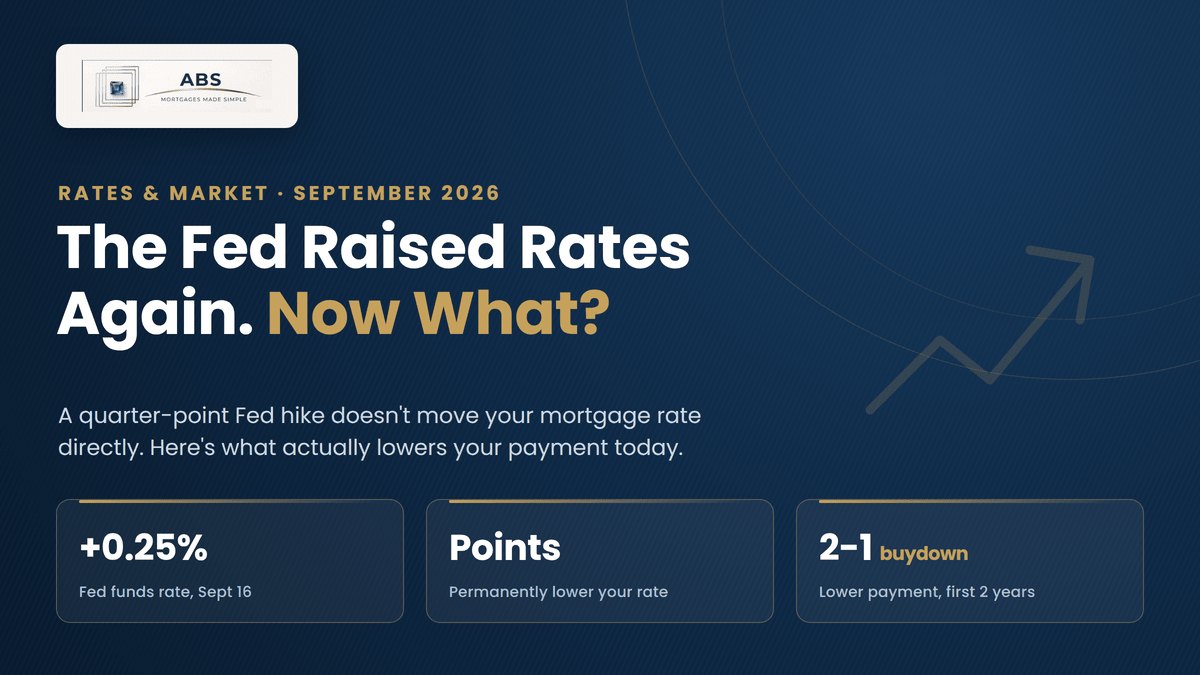
Choose the Tool by Running the Math
Points and temporary buydowns can both lower a payment, but their cost, timing, and breakeven work differently.
Two different tools
A point changes your rate forever; a temporary buydown changes your payment for a few years and then steps up. They solve different problems.
Often paid by someone else
Points and temporary buydowns can be funded by you, the seller, or the builder — and on eligible loans, we also offer a lender-paid temporary buydown, where we cover some or all of the cost instead of you.
The breakeven is the whole decision
For points, compare the upfront cost to the monthly savings. If you'd refinance or sell before breakeven, a point usually doesn't pay for itself.
Qualifying isn't automatic
Some loan programs let you qualify at the bought-down payment; most require qualifying at the full note rate. We check this before you count on it.
Discount Points vs. Temporary Buydowns vs. No Buydown
A side-by-side look using a $400,000 loan at a hypothetical 7.00% note rate.
| Option | How it works | Cost | Payment path | Best when |
|---|---|---|---|---|
| Discount Points | Permanently buys the rate down; about 0.25% per point is a rule of thumb, but pricing varies daily. | 1% of the loan amount per point — $4,000 on $400,000. | Lower principal-and-interest payment for the full loan term. | You're confident you'll hold the loan and rate past the roughly five-year breakeven in this example. |
| 2-1 Temporary Buydown | Escrowed funds subsidize the payment; the 7.00% note rate never changes. Available on conventional and FHA loans. | About $9,300 to fund in this example. | 5.00% effective in year 1 ($2,147/month), 6.00% in year 2 ($2,398/month), then the full 7.00% payment ($2,661/month) in year 3 and after. | You or the seller or builder want lower early payments, and you can afford the year-3 step-up regardless of future rates. |
| 3-2-1 Temporary Buydown | Escrowed funds subsidize three years of payments; the 7.00% note rate stays fixed. Available on conventional loans only — not currently offered on FHA. | About $18,300 to fund in this example. | Starts at a 4.00% effective rate, then steps to 5.00% in year 2, 6.00% in year 3, and the full 7.00% note-rate payment in year 4 and after. | A larger concession is available and the scheduled step-ups fit your budget without depending on a refinance. |
| No Buydown | Take the market rate without paying for a lower rate or subsidized early payment. | No upfront buydown cost. | The full note-rate payment begins immediately and stays level on a fixed-rate loan. | Keeping cash for reserves or a larger down payment has more value than using it upfront without a clear payoff. |
Figures are hypothetical illustrations on a $400,000 loan at an assumed 7.00% note rate, matching the example in our full rate-hike breakdown — not a quote, and not a commitment to lend. Temporary buydown structures vary by loan program — the 3-2-1 option shown here applies to conventional financing; FHA supports the 1-0 and 2-1 structures only. Actual pricing depends on your credit profile, loan program, property, and the market the day you lock.
Program at a Glance
The structure is predictable; the actual cost and qualifying treatment depend on the loan, investor, and market when you lock.
- Discount point cost
- 1% of loan amount per point
- Typical rate impact
- About 0.25% per point; varies by lender, program, and the day you lock
- 1-0 buydown
- 1% effective-rate reduction in year 1 only — available on conventional and FHA loans
- 2-1 buydown
- 2% effective-rate reduction in year 1, 1% in year 2 — available on conventional and FHA loans
- 3-2-1 buydown
- 3% effective-rate reduction in year 1, 2% in year 2, 1% in year 3 — conventional loans only; not currently offered on FHA
- Buydown availability by program
- As of September 2026, subject to change: conventional loans support 1-0, 2-1, and 3-2-1. FHA loans support 1-0 and 2-1 only. VA, USDA, jumbo, and non-QM availability varies by investor — confirmed before you rely on it.
- Who can fund a buydown
- Buyer, seller, builder, or ABS Home Mortgage (lender-paid) for temporary buydowns; buyer- or seller-paid points; subject to loan-program contribution limits and eligibility
- Qualifying rate
- Program- and investor-dependent — confirmed before you rely on it
Rate Buydown FAQs
See whether a buydown fits your rate lock
We'll compare points, temporary buydowns, and no buydown using your actual pricing and expected time in the loan.
Also see: all loan products · full rate-hike and buydown breakdown
Related Reading
The Fed Raised Rates Again. Here's What Actually Helps Your Payment Right Now
Why a quarter-point Fed hike doesn't map directly onto your mortgage rate, and how discount points and 1-0, 2-1, and 3-2-1 temporary buydowns actually work.
Read articleStop Waiting for the 'Perfect' Rate: A Smarter Way to Buy a Home in 2026
Waiting for mortgage rates to plunge has quietly become one of the most expensive mistakes a homebuyer can make. Here's what today's market actually looks like.
Read articleNo Closing Cost Refinance: Why It Matters Most If Rates Drop Again
We cover the closing costs associated with the loan — which means no break-even to wait for. If rates drop again, you may be able to refinance again.
Read article