Conventional Loans Up to $850,000: What Is Available Now

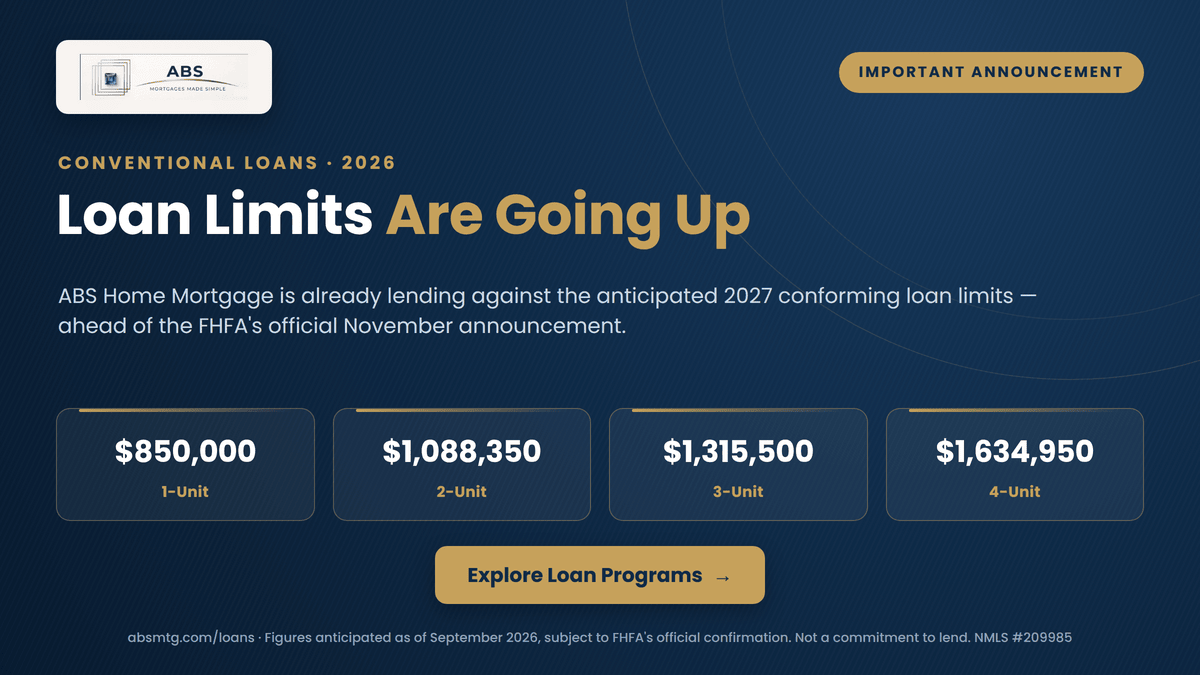
Certain lenders have announced higher conventional loan amounts, and we can use those programs now. For a one-unit home, that means a loan amount up to $850,000, subject to the participating lender’s requirements.
I want to keep this practical: the question is what financing is available for your property today, not how it compares with last year’s limits.
As of October 10, 2026, the amounts below are available through participating lenders and are subject to change. They are lender-announced program amounts, not a statement that FHFA has confirmed these as its official 2027 conforming loan limits.
Available conventional loan amounts
| Property type | Available loan amount |
|---|---|
| 1-unit | $850,000 |
| 2-unit | $1,088,350 |
| 3-unit | $1,315,500 |
| 4-unit | $1,634,950 |
These are loan amounts, not home purchase prices. Your down payment and the financing you qualify for determine how a purchase fits within the applicable program.
Availability depends on the lender, property location, unit count, occupancy, and your complete application. We’ll confirm the applicable amount and requirements before recommending a program. An amount in this table is not an approval or a promise that every lender offers the same option.
What this means for your purchase or refinance
If your financing needs fit within these amounts, we can review the participating lenders’ conventional options now. You do not need to wait for a future FHFA announcement to ask us what is available.
I would start with the property and the loan amount you need, then compare the programs that actually fit. A higher available amount does not automatically mean a lower rate, a smaller down payment, or a better loan for your situation.
If your financing needs fall outside the applicable program, we can also review jumbo loan options. Our article about a $1.4 million jumbo closing in Chicago gives another perspective on larger loans. Closing timelines vary by file, and no timeline is guaranteed; transaction details in that article were generalized to protect client privacy.
FHA limits remain unchanged for now
The higher conventional amounts above do not change FHA loan limits. As of October 10, 2026, FHA limits remain unchanged for now and are subject to future updates.
FHA is a separate program. We’ll check the applicable FHA limit for your county and property type rather than apply the conventional table to an FHA loan. For a closer look at that program, read my FHA loan guide or visit our FHA loans page.
If the limits change later
If FHFA announces different official limits or a participating lender changes its program, we can update this article accordingly. For an active application, we’ll confirm the requirements that apply to your file rather than treat this page as a rate lock, approval, or guarantee of future availability.
Find the right program for your property
Tell us the property location, number of units, purchase price or refinance goal, and expected loan amount. We can review the available options and explain which requirements apply.
Explore our loan programs, request today’s rate, or call 630-357-1600. If this is your first purchase, my Naperville first-time buyer guide is another place to start.
Common questions
Can I apply for a conventional loan up to $850,000 now?
Yes. As of October 10, 2026, participating lenders offer conventional loan amounts up to $850,000 for one-unit homes, subject to change. Availability depends on the lender, property, occupancy, and your complete application; the amount is not an approval.
What amounts are available for two- to four-unit properties?
The participating-lender amounts are $1,088,350 for two units, $1,315,500 for three units, and $1,634,950 for four units. These are loan amounts, not purchase prices, and are subject to the lender’s requirements and change.
Are these confirmed FHFA limits for 2027?
This article describes lender-announced program amounts available now, not confirmed official FHFA limits for 2027. If FHFA announces different official limits or participating lenders change their programs, we can update the article.
Have FHA limits increased too?
No. As of October 10, 2026, FHA limits remain unchanged for now. The higher conventional amounts in this article do not change FHA limits; we’ll check the applicable FHA limit for your county and property type.
Does a higher available loan amount guarantee a better loan?
No. A higher available amount does not automatically mean a lower rate, a smaller down payment, or a better loan for your situation. We’ll compare the programs that fit your property and financing needs.
Follow us on Google: Add ABS Home Mortgage as a preferred source
Related Reading
We Closed a $1.4 Million Jumbo in 12 Calendar Days
A Chicago-area buyer won a multiple-offer bid by agreeing to a non-refundable deposit and a 12-day close. Here's the day-by-day of how the file closed on time.
Read articleFirst-Time Home Buyer Guide: Naperville 2026
What you can actually afford with DuPage County taxes, down payment minimums, neighborhood pricing by ZIP, Illinois assistance programs, and the pre-approval process.
Read articleFHA Loans in 2026: What 3.5% Down Actually Costs You
Credit score minimums, 2026 loan limits, how long mortgage insurance really lasts, gift funds, seller credits, and when conventional costs less.
Read articleMore in Rates & Market News · All mortgage guides